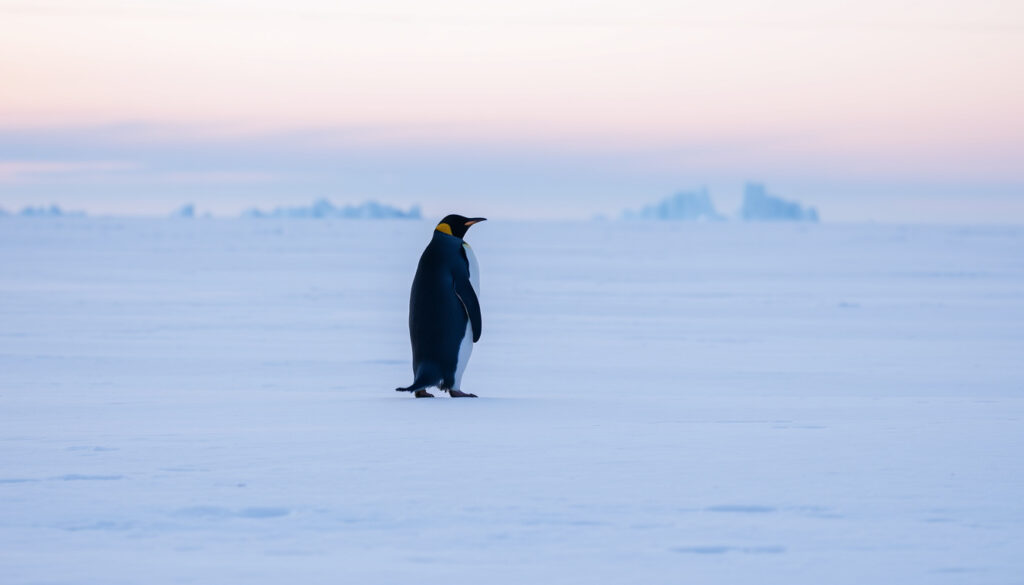
Emperor Penguin – Complete Guide to Antarctica’s Largest Bird
Emperor penguins are the largest penguin species on Earth, standing up to 1.3 metres tall and weighing as much as 45 kilograms. They are the only animals that breed during the Antarctic winter, huddling together on sea ice in one of the most extreme environments on the planet. This guide covers their size, habitat, diet, breeding cycle, conservation status, and how they compare to king penguins.
How tall is an emperor penguin? Physical characteristics of the largest penguin
| Scientific Name Aptenodytes forsteri |
Average Height 100–122 cm (39–48 in) |
Average Weight 22–45 kg (49–99 lb) |
Unique Fact Breeds during the Antarctic winter |
- Emperor penguins are the tallest and heaviest of all penguin species, perfectly adapted to extreme cold.
- They rely on huddling behaviour to conserve heat during frigid winter storms.
- Unlike most birds, they breed in the harshest season, using sea ice as a platform for colonies.
- Climate change and sea ice loss pose the greatest threat to their long-term survival.
- The male incubates the single egg on its feet under a brood pouch for about 64–67 days without eating.
| Attribute | Measurement |
|---|---|
| Height | 100–122 cm (39–48 in) – tallest penguin |
| Weight | 22–45 kg (49–99 lb) – heaviest penguin |
| Lifespan | 15–20 years in the wild, up to 30 in captivity |
| Diet | Fish (e.g., lanternfish), krill, squid |
| Breeding | One egg per year, incubated by male |
| Incubation period | ~64–67 days |
| Population | ~600,000 individuals (IUCN Near Threatened, 2024/2025) |
Emperor penguins stand about 1.1 to 1.3 metres tall, according to the WWF and the Antarctic and Southern Ocean Coalition. Adults commonly weigh around 40 kilograms at the start of the breeding season, with a broader range of 20 to 45 kilograms depending on the time of year. Their dense plumage, which consists of about 100 feathers per square inch, is often mistaken for hair. They have a wingspan of about 76 to 89 cm, though their wings are adapted for swimming rather than flight.
Emperor penguin vs king penguin: What’s the difference?
Emperor and king penguins look similar at first glance, with black-and-white bodies and yellow-orange markings on the neck. But they are different species with distinct sizes, habitats, and breeding cycles.
Size comparison
Emperor penguins are significantly larger than king penguins. Emperors can reach 1.3 metres and weigh up to 45 kilograms, while king penguins typically stand about 85 to 95 cm tall and weigh 11 to 16 kilograms. The emperor is the largest penguin species overall, as confirmed by Wikipedia and National Geographic.
Breeding and habitat differences
Emperor penguins breed on sea ice during the Antarctic winter, a strategy no other penguin uses. King penguins, by contrast, breed in the milder subantarctic region on land or ice-free beaches. This difference in breeding environment means emperor penguins have evolved more extreme cold-adaptation traits, such as dense plumage, thick blubber, and huddling behaviour.
If you see a large penguin with yellow-orange patches on the side of the head that blend into the upper chest, it is likely an emperor. King penguins have brighter, more solid orange patches that are confined to the sides of the head and do not extend as far down the chest.
Where do emperor penguins live? Habitat and range in Antarctica
Emperor penguins live exclusively in Antarctica and spend their entire lives around Antarctic ice. According to the Australian Antarctic Division, they are the most southerly breeding penguin and the only one that breeds on sea ice rather than on land.
Year-round presence
They do not migrate to warmer regions. Instead, they remain in Antarctic waters throughout the year, using the sea ice as a platform for breeding, moulting, and resting. Colonies are scattered around the Antarctic continent where stable sea ice forms.
Habitat requirements
Stable sea ice is essential for successful breeding. The ice must be thick enough to support the colony for several months and must remain intact through the winter. This dependence on sea ice makes emperor penguins highly vulnerable to climate change.
How do emperor penguins survive the cold? Adaptations for the Antarctic winter
Emperor penguins have evolved a suite of biological and behavioural adaptations that allow them to withstand temperatures as low as -60°C and winds of up to 200 km/h.
Physical adaptations
Their dense plumage consists of multiple layers: a waterproof outer layer of stiff feathers and a soft, downy inner layer that traps air for insulation. Beneath the skin, a thick layer of fat provides additional insulation and an energy reserve. They also have a counter-current heat exchange system in their flippers and legs that minimises heat loss.
Behavioural huddling
When temperatures drop, emperor penguins gather in tight huddles that can contain thousands of birds. Individuals on the colder outer edge gradually move toward the warmer centre, so the entire huddle shifts slowly over time. This behaviour reduces heat loss by up to 50 per cent.
Emperor penguins can dive deeper than any other bird. Documented dives exceed 500 metres, and they can remain underwater for more than 20 minutes. Their bodies are adapted to store large amounts of oxygen in their muscles and blood, allowing prolonged foraging trips under the ice.
Movement on ice and in water
On land, they often toboggan on their bellies to move quickly across the ice. In the water, they are powerful swimmers, reaching speeds of up to 10–15 km/h when chasing prey.
Emperor penguin lifecycle: Egg incubation, breeding, and chick development
The annual breeding cycle of the emperor penguin is one of the most remarkable in the animal kingdom. It unfolds in a precise sequence tied to the Antarctic seasons.
- March–April: Adults return to breeding colonies after feeding at sea. (Source: Australian Antarctic Division)
- May–June: Females lay a single egg, transfer it to the male, and leave to feed at sea.
- June–July: Males incubate eggs on their feet under a brood pouch, eating nothing for about 64–67 days.
- July–August: Eggs hatch. Males feed chicks a milky secretion from their oesophagus.
- August–September: Females return to take over feeding the chick; males go to sea to feed.
- September–November: Chicks grow rapidly. Both parents make foraging trips to bring food.
- December–January: Chicks fledge (moult into juvenile plumage) and head to open sea.
The typical lifespan of an emperor penguin in the wild is about 15–20 years, though some individuals may live longer, according to the Antarctic and Southern Ocean Coalition and National Geographic.
Are emperor penguins endangered? Conservation status and threats
The conservation outlook for emperor penguins has become increasingly concerning. The IUCN Red List currently classifies the species as Near Threatened, but some sources now report a shift to Endangered as of 2026, reflecting a worsening situation.
| Established information | Information that remains unclear |
|---|---|
| Emperor penguins have feathers, not hair. Their dense plumage provides waterproofing and insulation. | The exact impact of climate change on population counts is still uncertain. While sea ice loss is a known threat, colony decline rates vary across regions. |
| Emperor penguins are flightless. Their wings are adapted for swimming, not flying. | IUCN status may be updated as sea ice projections mature. Some models predict significant population declines by 2100, but the rate remains debated. |
| Emperor penguins are endemic to Antarctica. They breed only on sea ice around the continent. | Estimates from the IPCC and penguin researchers differ on the exact rate of decline. The consensus is negative, but the magnitude is still being studied. |
Stable winter sea ice is essential for emperor penguin reproduction. Climate change is causing sea ice to form later and break up earlier, which can lead to breeding failure and reduced chick survival. This makes emperor penguins a key indicator species for warming in the Southern Ocean.
Why are emperor penguins so important for understanding climate change?
Emperor penguins are considered a sentinel species for the Antarctic ecosystem. Their reliance on stable sea ice for breeding means that any change in ice conditions directly affects their survival. Scientists monitor colonies via satellite imagery through programs run by the British Antarctic Survey and the Alfred Wegener Institute. These data help researchers track how warming trends are impacting the Southern Ocean.
Conservation efforts include the establishment of Marine Protected Areas around Antarctica and proposals to regulate tourism to minimise disturbance. The emperor penguin has also become a cultural icon through films such as March of the Penguins, yet misconceptions about its biology remain common.
What do authoritative sources say about emperor penguins?
“Emperor penguins are amazing birds. They not only survive the Antarctic winter, but they breed during the worst weather conditions on earth.”
— Australian Antarctic Division
“Emperor Penguins are high latitude, ice obligate seabirds; they breed throughout the austral winter.”
— BirdLife International
“The emperor penguin is the tallest and heaviest of all living penguin species.”
— Wikipedia
What does the future hold for emperor penguins?
Continued satellite monitoring of emperor penguin colonies will be essential for tracking population trends. The IUCN status may be updated as sea ice projections improve. Growing public interest, driven by conservation campaigns and digital content such as 3D models and interactive maps, is helping to raise awareness. For a broader overview of Antarctic wildlife, see our Complete guide to Antarctic penguins. To understand the wider context of warming in polar regions, read more about How climate change affects polar animals.
Frequently asked questions about emperor penguins
How many emperor penguins are left in the wild?
A 2009 satellite-based estimate put the population at about 595,000 adults, or around 238,000 breeding pairs. More recent assessments have not produced a significantly different global figure.
What is the scientific name of the emperor penguin?
The scientific name is Aptenodytes forsteri.
Can emperor penguins fly?
No. Emperor penguins are flightless birds. Their wings are adapted for swimming, not flying.
How deep can emperor penguins dive?
They can dive deeper than any other bird, with documented dives exceeding 500 metres. They can remain underwater for more than 20 minutes.
Do emperor penguins eat krill?
Yes. Their diet consists mainly of fish, especially Antarctic silverfish, but also includes krill, squid, and other cephalopods and crustaceans.
How do emperor penguins find a mate?
They use vocal calls to identify and locate their mate among thousands of birds in the colony. Each penguin has a unique call that its partner recognises.
How long do emperor penguin chicks stay with their parents?
Chicks stay with their parents for about five months, from hatching in July–August until fledging in December–January.
What is the average weight of an emperor penguin egg?
An emperor penguin egg weighs about 450–500 grams, which is relatively large for a bird of its size.
Why do emperor penguins huddle together?
Huddling is a behavioural adaptation to conserve heat. By gathering in dense groups, they reduce heat loss by up to 50 per cent during the harsh Antarctic winter.
How is climate change affecting emperor penguins?
Climate change is causing sea ice to form later and break up earlier. This reduces the availability of stable breeding platforms and can lead to breeding failure and lower chick survival rates.
More related posts
 Jadon Sancho – Free Agent in 2026 After Man United Exit
 Fetty Wap – Biography, Eye Condition, and Prison Sentence
 Liver King – Biography, Net Worth, and 2025 Controversy
 Adrian Chiles – Biography, Career and 2026 Schedule
 Emma Thompson – Biography, Movies, Age and Net Worth 2025
 Oliver Cromwell – Life, Death, and Controversial Legacy
 Sirius Black – Complete Character Guide and Biography
 Heather Locklear – Health, Relationship and Career Updates
