Jackson Pollock – Biography, Art Style and Record Prices
Jackson Pollock, the American painter who redefined modern art with his radical drip technique, remains one of the most influential and controversial figures of the 20th century. Born in Cody, Wyoming, in 1912, he rose from modest beginnings to become the defining face of Abstract Expressionism, a movement that shifted the center of the art world from Paris to New York. His life was as turbulent as the canvases he created, marked by brilliant innovation, personal struggle, and a tragic early death that cemented his mythic status.
Pollock produced fewer than 400 major paintings during his lifetime, yet his work continues to dominate museum collections and command record-breaking prices at auction. His most famous piece, Number 5, 1948, reportedly sold for $140 million in a private transaction, placing him among the most valuable artists in history. This article examines his biography, his revolutionary technique, the market for his work, and where his most important pieces can be seen today.
Who Was Jackson Pollock? Biography and Legacy
January 28, 1912, Cody, Wyoming
August 11, 1956 (age 44), East Hampton, New York
Abstract Expressionism
‘Drip Technique’, ‘Blue Poles’, ‘Number 5, 1948’
Paul Jackson Pollock was the youngest of five sons born to Stella May McClure and LeRoy Pollock. The family moved several times during his childhood, eventually settling in California. In 1930, Pollock moved to New York City to study at the Art Students League under the regionalist painter Thomas Hart Benton. Benton’s influence can be seen in Pollock’s early figurative work, though he would soon abandon representation entirely.
Key Insights
- Jackson Pollock revolutionized modern art with his radical ‘drip technique’, breaking away from traditional easel painting.
- His painting ‘Number 5, 1948’ sold for $140 million in 2006, making it one of the most expensive paintings ever sold at the time.
- Pollock’s career was tragically cut short by a fatal car crash at age 44, cementing his mythic status in American art.
- Major institutions including MoMA, Tate, and Guggenheim hold key works, making his art widely accessible to the public.
| Fact | Detail |
|---|---|
| Full Name | Paul Jackson Pollock |
| Birth | January 28, 1912, Cody, Wyoming, USA |
| Death | August 11, 1956 (age 44), East Hampton, New York |
| Cause of Death | Automobile accident (alcohol-related single-car crash) |
| Art Movement | Abstract Expressionism (Action Painting) |
| Most Expensive Work | ‘Number 5, 1948’ – $140 million (private sale, 2006) |
| Signature Technique | Drip and pour painting on canvas laid on the floor |
Pollock married the artist Lee Krasner in 1945. Krasner was a significant figure in her own right and played a crucial role in managing his career and legacy. The couple moved to Springs, East Hampton, New York, where Pollock converted a barn into his studio. It was there that he developed the technique that would define his career.
What Is Jackson Pollock’s Art Style? The Drip Technique Explained
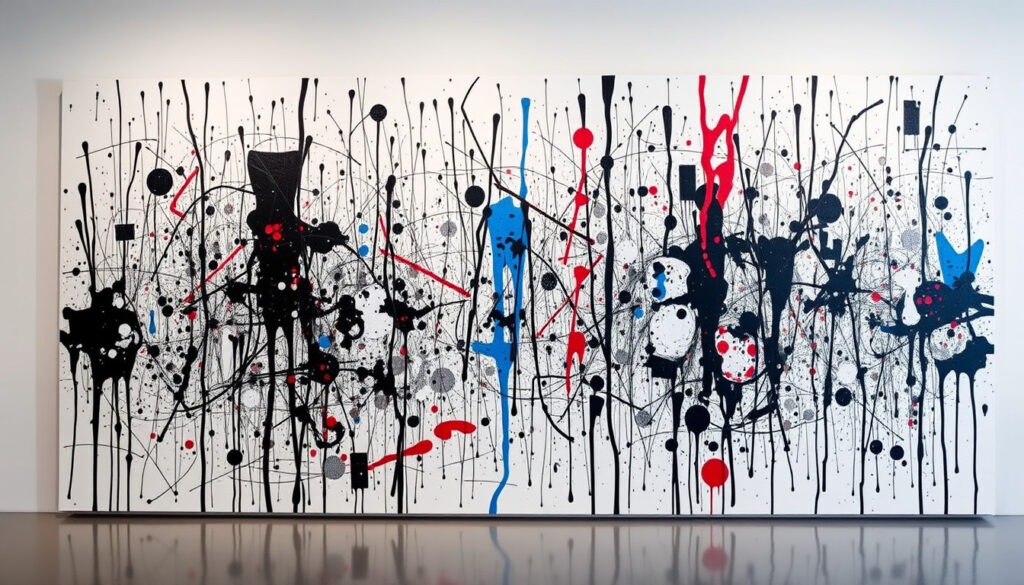
Pollock’s mature style is inseparable from what became known as the ‘drip technique’. Rather than placing canvas on an easel, he laid it flat on the floor. This allowed him to approach the work from all four sides, pouring, dripping, and flinging paint in controlled yet seemingly chaotic gestures. He used sticks, hardened brushes, and basting syringes to apply house paint in layered, rhythmic patterns.
This method eliminated any single focal point, creating what critics called ‘all-over’ compositions. The physical act of painting became as important as the finished work, which led the critic Harold Rosenberg to coin the term action painting. Pollock’s approach was a radical break from centuries of European painting tradition, and it positioned him at the forefront of the Abstract Expressionist movement.
Pollock laid his canvas flat on the floor, allowing him to work from all sides. He used sticks, hardened brushes, and even basting syringes to drip and fling paint in complex, layered patterns. This method created what critics called ‘all-over’ compositions with no single focal point. The physicality of the process was central to the work’s meaning.
What defines Abstract Expressionism?
Abstract Expressionism emerged in New York in the 1940s and 1950s as the first American art movement to gain international dominance. It emphasized spontaneous, automatic, or subconscious creation. Pollock, along with artists like Willem de Kooning and Mark Rothko, became its most celebrated figures. The movement is broadly divided into action painters, who emphasized gesture, and color field painters, who focused on large areas of color.
Why is Pollock considered a major figure in Abstract Expressionism?
Pollock’s drip technique represented the most extreme departure from traditional painting of any artist in the movement. His work embodied the principles of action painting more completely than any of his contemporaries. The sheer scale and energy of his canvases, combined with his dramatic personal story, made him the public face of American avant-garde art. His influence extended well beyond painting, affecting sculpture, performance, and later conceptual art.
What Is the Most Expensive Jackson Pollock Painting?
The most expensive Jackson Pollock painting ever sold is Number 5, 1948, which reportedly changed hands in a private sale for $140 million in 2006. At the time, it was the highest price ever paid for a painting, though the exact identity of the buyer and the full terms of the transaction were never publicly confirmed. Adjusted for inflation, the equivalent value today is approximately $163.8 million.
The sale was brokered by the collector David Geffen, who sold the painting to the Mexican financier David Martínez. The transaction placed Pollock in an elite group of artists whose work has exceeded the $100 million threshold, alongside Pablo Picasso, Andy Warhol, and Gustav Klimt.
The $140 million sale of Number 5, 1948 remains one of the highest prices ever paid for a painting. The buyer and exact terms were never publicly confirmed, which is common in private sales of this magnitude. Art market analysts point to Pollock’s scarcity and historical importance as key drivers of value. Fewer than 400 major Pollock paintings exist, and demand from ultra-wealthy collectors remains intense.
How much is a Jackson Pollock painting worth?
Prices for Jackson Pollock paintings vary dramatically depending on size, provenance, and market conditions. Smaller works on paper can sell for several million dollars, while major drip paintings from his peak period (1947–1950) routinely command tens of millions at auction. In 2012, Number 4, 1951 sold at Sotheby’s for $40.4 million. The market for Pollock’s work has remained consistently strong, with rare pieces appearing at auction only infrequently.
Why is Pollock’s painting worth $140 million?
The value of Number 5, 1948 is driven by several factors: its place in Pollock’s most celebrated period, its large size (8 feet by 4 feet), its impeccable provenance, and the extreme scarcity of major drip canvases. Fewer than 30 paintings of this scale and quality from Pollock’s peak years remain in private hands. The buyer paid not just for the object but for a piece of 20th-century cultural history.
What Is the Significance of ‘Blue Poles’?
Blue Poles: Number 11, 1952 is one of Pollock’s most recognizable large drip paintings. Measuring nearly 7 feet tall and 16 feet wide, the work is dominated by eight bold vertical lines of blue paint that cut across the intricate web of dripped and poured color. It was created in 1952, toward the end of Pollock’s most productive period.
The painting gained international attention in 1973 when the National Gallery of Australia acquired it for US$2 million. At the time, it was the highest price ever paid for a modern American painting. The acquisition sparked public debate in Australia about the cost of the work and the wisdom of spending such a sum on a contemporary piece. Today, it is regarded as a masterwork and a cornerstone of the museum’s collection.
Acquired by the National Gallery of Australia in 1973 for what was then a record price for a modern American painting, Blue Poles stirred national debate about public art funding. Today it is considered a cornerstone of the gallery’s collection and a masterpiece of Abstract Expressionism. The painting is on permanent display at the museum in Canberra.
Key Milestones in Jackson Pollock’s Life and Career
- 1912 – Born in Cody, Wyoming, youngest of five sons.
- 1930 – Moved to New York City to study at the Art Students League under Thomas Hart Benton.
- 1943 – First solo exhibition at Peggy Guggenheim’s Art of This Century gallery.
- 1947 – Developed the ‘drip technique’, laying canvas on the floor.
- 1948 – Created Number 5, 1948 (later sold for $140 million).
- 1952 – Painted Blue Poles, now a centerpiece of the National Gallery of Australia.
- 1956 – Died in a single-car accident in East Hampton, New York.
- 2006 – Number 5, 1948 sold privately for $140 million, a record at the time.
What Do We Know for Certain About Jackson Pollock?
| Established Information | Information That Remains Unclear |
|---|---|
| Jackson Pollock was born on January 28, 1912, in Cody, Wyoming. | The exact price and buyer of the $140 million sale of Number 5, 1948 remain unconfirmed by public sale records. |
| He died on August 11, 1956, in an automobile accident. | The authenticity and attribution of some works, particularly lesser-known pieces, continue to be studied and debated. |
| He is widely recognized as a leading figure in the Abstract Expressionist movement. | The exact date of some early works is uncertain due to limited documentation. |
| His painting Number 5, 1948 was sold in a private transaction for $140 million in 2006. |
Why Jackson Pollock’s Work Commands Such High Prices
Pollock’s prices are driven by his pivotal role in art history, the scarcity of his major works, and the high demand from ultra-wealthy collectors. Fewer than 400 major paintings exist, and most are held by museums, meaning that works entering the market are exceptionally rare. His drip technique broke with all painting conventions, making his canvases icons of American innovation and freedom.
The $140 million sale of Number 5, 1948 reflected not just the painting itself but the buyer’s acquisition of a piece of 20th-century cultural history. Blue Poles, sold to the National Gallery of Australia, similarly achieved a record price at auction, cementing Pollock’s market position. Art market analysts note that Pollock’s paintings are among the most stable investments in the contemporary art market, with values that have consistently appreciated over time.
His work is represented in major institutions worldwide. The action painting technique he pioneered is taught in art schools globally, and his influence extends across painting, sculpture, and performance art. Museums including MoMA, the Tate, and the Guggenheim hold significant collections of his work, ensuring that new generations continue to encounter his art firsthand.
Where to Find Reliable Information About Jackson Pollock
Several authoritative sources provide well-documented information about Pollock’s life and work. Museum websites offer curated biographies and collection details, while academic sources provide deeper analysis of his technique and historical context.
“Jackson Pollock was an American painter. A major figure in the abstract expressionist movement, he was widely noticed for his drip technique.”
– Wikipedia
“Jackson Pollock was born on January 28, 1912, in Cody, Wyoming.”
– Guggenheim Museum
“Jackson Pollock 1912–1956”
– Tate Museum
What Is Jackson Pollock’s Lasting Legacy?
Jackson Pollock fundamentally changed the course of modern art. His drip technique broke with centuries of painting tradition and helped establish the United States as the center of the postwar art world. His work continues to command record prices, draw millions of museum visitors annually, and inspire artists across disciplines. Despite his short life and troubled personal history, Pollock’s artistic achievements remain as influential today as they were in the 1950s.
Frequently Asked Questions
Did Jackson Pollock have children?
No, Jackson Pollock and his wife Lee Krasner did not have children.
Was Jackson Pollock an alcoholic?
Yes, Pollock struggled with alcoholism for much of his adult life, which contributed to his death in a car accident.
What is the difference between Pollock and other abstract expressionists?
Pollock uniquely used the ‘drip technique’ on canvas laid flat, creating all-over compositions without a central focal point.
How many Jackson Pollock paintings exist?
Estimates are around 350–400 known paintings, with many smaller works and drawings also surviving.
Is there a Jackson Pollock documentary?
Yes, the 2000 film ‘Pollock’ starring Ed Harris is a well-known biographical drama.
More related posts
 London Hotel Afternoon Tea: The £35 to £95 Price Divide Explained
 What Is an Acronym – Definition, Examples vs Initialism
 Sandi Toksvig – Biography, Wife, Children, Height and Career 2025
 Jack Carroll – Age, Disability, Career, and Net Worth
 Orlando Bloom Katy Perry – Allt om splitten 2025
 Brian McFadden – Net Worth, Wife, Children, and Career Timeline
 Lucy Connolly – 31-Month Sentence, Appeal and Release
 Saturn Devouring His Son – Goya’s Darkest Masterpiece Explained
