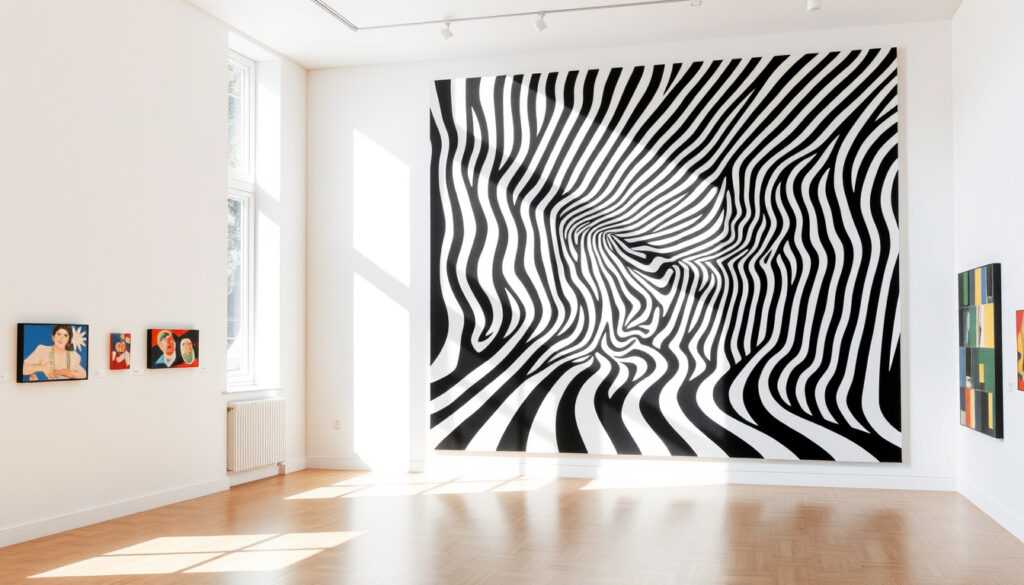
Bridget Riley Artist – Biography, Art Style, and Famous Works
Bridget Riley is one of the most significant British painters of the 20th century, a pioneer of the Op Art movement whose geometric abstractions challenge the very act of seeing. Born in 1931, she remains a vital force in contemporary art, with a career spanning over six decades and a recent major exhibition at the Musée d’Orsay.
Her work, characterized by precise patterns and stark contrasts, creates illusions of movement and depth that can feel almost physical. Riley’s influence extends far beyond the gallery, shaping fashion, design, and how we understand visual perception itself.
Now in her nineties, she continues to work from studios in London, Cornwall, and France, proving that her exploration of optical phenomena remains as urgent as ever.
Who is Bridget Riley?
Bridget Riley is an English painter who became the leading figure of the Op Art movement in the 1960s. Her work uses precise geometric patterns to create powerful optical illusions of movement, vibration, and depth.
- Bridget Riley (b. 1931) is a British painter who pioneered the Op Art (optical art) movement in the 1960s.
- Her early black-and-white works created illusionary movement and vibration using geometric patterns.
- She later incorporated color, exploring how hues interact to produce spatial depth and rhythm.
- Riley has been celebrated globally with major retrospectives at the Tate, MoMA, and the Morgan Library.
- Despite her age, she remains active, with recent exhibitions and a continued interest in her prints.
| Fact |
|---|
| Born in London in 1931, spent childhood in Cornwall and Lincolnshire. |
| Studied at Goldsmiths’ College (1949–1952) and Royal College of Art (1952–1955). |
| First exhibited mature Op Art works in 1961; gained fame in 1965 with ‘The Responsive Eye’ exhibition at MoMA. |
| Represented Britain at the Venice Biennale in 1968 (first woman to do so). |
| Recipient of numerous honors, including the Japan Art Association’s Praemium Imperiale (2003) and Order of the Companions of Honour (2022). |
Is Bridget Riley still alive?
Yes, Bridget Riley is still alive. As of 2025, she is 94 years old and continues to work from her studios in London, Cornwall, and the Vaucluse region of France.
Her most recent major exhibition, Point de départ, concluded at the Musée d’Orsay in Paris in 2025–2026, confirming her ongoing creative output. She remains a vital presence in the art world, with galleries such as David Zwirner representing her work.
Bridget Riley is alive and active at age 94. She continues to paint and exhibit, with her most recent major show at the Musée d’Orsay in Paris concluding in 2025–2026.
Where does Bridget Riley live now?
Riley maintains multiple residences and studios. She lives and works in London, Cornwall, and the Vaucluse region of France. The exact details of her daily life are not fully public, but these locations are well-documented in biographies from the Tate and other authoritative sources.
What is Bridget Riley’s art style?
Bridget Riley’s art style is defined by optical abstraction. She creates paintings that appear to move, vibrate, or shift in depth, using precise arrangements of lines, curves, and color fields.
What is optical art?
Optical art, or Op Art, is a style of visual art that uses geometric patterns and color contrasts to create optical illusions. The viewer’s eye is tricked into perceiving movement, flashing, or three-dimensional space on a flat surface. Riley is widely considered the leading exponent of this movement.
Key characteristics of Riley’s work
Riley’s technique is built on mathematical precision, though she describes her process as instinctive. She creates extensive preparatory drawings to test spacing and color. Successful studies become full-size paper and gouache cartoons, which are then enlarged, ruled up, under-painted with acrylic, and over-painted in oils.
Despite the grid-like appearance, everything is painted by hand. She uses no rulers, masking tape, or mechanical means when applying paint. Due to the large scale and need for extreme precision, Riley has worked with assistants since the 1960s.
She worked exclusively in black and white (with occasional greys) until the late 1960s. In 1967, she introduced color, expanding her perceptual experiments to include rich arrays of alternating hues that produce illusions of topography.
Riley’s process is both methodical and intuitive. She creates preparatory drawings to test spacing and color, then enlarges them into full-size cartoons. The final painting is executed by hand in acrylic and oils, with no mechanical aids.
What are Bridget Riley’s most famous artworks?
Riley’s most famous works include Fall (1963), a seminal black-and-white piece that creates a disorienting physical effect on the eye, and Kiss (1961), one of her first purely geometric works. Other notable pieces include early experiments with squares, lines, and ovals.
Major exhibitions
Riley’s career has been marked by landmark exhibitions. In 1962, she held her first solo exhibition at Gallery One in London. The 1965 show The Responsive Eye at the Museum of Modern Art (MoMA) in New York catapulted Op Art to global fame. In 1968, she won the International Painting Prize at the Venice Biennale, becoming the first woman to receive the honor.
Major retrospectives followed at the Tate Gallery in London (2003) and the Musée d’Art Moderne in Paris (2008). Her most recent solo exhibition, Point de départ, concluded at the Musée d’Orsay in 2025–2026.
Does Bridget Riley sell prints?
Yes, Bridget Riley has produced prints for over 50 years. Her printmaking runs parallel to her painting, translating her geometric patterns into more accessible formats. Authorized prints and editions are typically sold through galleries like David Zwirner, or through the official Bridget Riley website. The Tate also offers licensed products.
Only purchase Bridget Riley prints from authorized galleries such as David Zwirner or the official website. Unauthorized reproductions are common and do not hold the same value or authenticity.
Who is Bridget Riley’s husband?
Bridget Riley has kept her personal life largely private. The available biographies do not mention a husband or confirm whether one is alive. Her biography focuses on her career and a personal artistic crisis related to a relationship that ended around 1960, which led her to abandon color and narrative in favor of pure optical phenomena.
Some sources indicate she never married, while others mention a brief marriage. Official biographies from the Wikipedia and the Tate do not confirm a current husband. This remains an area of uncertainty in her personal history.
Timeline of Bridget Riley’s career
- 1931 – Born in London, England.
- 1949–1952 – Studied at Goldsmiths’ College.
- 1952–1955 – Studied at Royal College of Art.
- 1961 – First exclusively geometric works; solo exhibition at Gallery One, London.
- 1965 – Included in ‘The Responsive Eye’ at MoMA, launching international fame.
- 1968 – First woman to represent Britain at the Venice Biennale.
- 2003 – Awarded Praemium Imperiale for painting.
- 2022 – Appointed Member of the Order of the Companions of Honour.
- 2024–2025 – Exhibition ‘Bridget Riley Drawings’ at the Morgan Library & Museum, New York.
What is known and what remains unclear about Bridget Riley’s life?
| Established information | Information that remains unclear |
|---|---|
| Bridget Riley was born on 24 April 1931 and is alive as of 2025. | Details of her current residence are not fully public (she lives between multiple locations). |
| She is an English painter known for Op Art works. | Her marital status and husband’s identity are not officially confirmed; some sources say she never married, others mention a brief marriage. |
| She studied at Goldsmiths’ and the Royal College of Art. | |
| She has had major exhibitions at Tate, MoMA, and the Morgan Library. | |
| She lived in London, Cornwall, and France. |
Analysis and context: Bridget Riley’s place in art history
Bridget Riley is widely regarded as the leading exponent of Op Art, a movement that emerged in the 1960s and focused on perceptual effects. Her work challenges the viewer’s eye using precise geometric patterns and color contrasts. She draws inspiration from Georges Seurat’s pointillism and the Bauhaus tradition.
Riley’s influence extends beyond fine art into design, fashion, and digital aesthetics. Her patterns were widely adopted in the 1960s, making her one of the most recognizable British artists of that era. Her commitment to abstraction and optical illusion has secured her legacy as a modern master.
She is recognized as Great Britain’s number one art celebrity of the “swinging sixties,” with her patterns influencing fashion, design, and advertising. She is celebrated for challenging viewers to question the reliability of their senses through carefully orchestrated shapes.
Sources and quotes on Bridget Riley
“I am not a minimalist, I am a painter of space.”
Bridget Riley, interview with The Guardian (2011)
“Riley’s paintings are not about optical trickery; they are about the experience of seeing itself.”
Tate Museum website
“Since 1961, Riley has focused exclusively on seemingly simple geometric forms, such as lines, circles, curves, and squares.”
David Zwirner Gallery
What is the legacy of Bridget Riley?
Bridget Riley’s legacy is that of a modern master who redefined what painting could do. By focusing on the mechanics of human vision, she created works that are both intellectually rigorous and visually thrilling. Her influence continues to be felt in contemporary art, design, and digital media. For those interested in exploring further, you can learn about the Op Art movement and its other key figures.
Frequently asked questions about Bridget Riley
What is optical art?
Optical art, or Op Art, is a style of visual art that uses geometric patterns and color contrasts to create optical illusions of movement, vibration, or depth. Bridget Riley is one of its most famous practitioners.
Is Bridget Riley married?
Bridget Riley has largely kept her personal life private. While some sources indicate she never married, others mention a brief marriage. Official biographies do not confirm a current husband.
Where can I buy Bridget Riley prints?
Authorized prints and editions are typically sold through galleries like David Zwirner, or through the official website bridgetrileyservices.com. The Tate also offers licensed products.
How did Bridget Riley influence art?
Riley demonstrated that pure abstraction could engage the viewer’s visual perception directly. Her work inspired a generation of artists and continues to influence contemporary art, design, and digital media.
How old is Bridget Riley?
Bridget Riley was born on 24 April 1931. As of 2025, she is 94 years old.
What is Bridget Riley’s most famous painting?
Fall (1963) is widely considered her most famous work. It is a black-and-white piece that creates a powerful, disorienting optical effect.
Did Bridget Riley win any major awards?
Yes. In 1968, she became the first woman to win the International Painting Prize at the Venice Biennale. She also received the Praemium Imperiale in 2003 and was appointed to the Order of the Companions of Honour in 2022.
What materials does Bridget Riley use?
Riley works with acrylic and oil paints on canvas. She also creates works on paper using gouache. Her process involves extensive preparatory drawings.
Is Bridget Riley still painting?
Yes, Bridget Riley is still painting. She remains active and recently concluded a major solo exhibition at the Musée d’Orsay in Paris.
Where did Bridget Riley study?
She studied at Goldsmiths’ College (1949–1952) and the Royal College of Art (1952–1955) in London.
More related posts
 Fra Fee – Actor, Les Misérables and Hawkeye Star
 Nadine Coyle – Biography, Relationships and 2025 Update
 Josh Allen – Age, College, Draft and Career Profile
 DJ Fat Tony – Biography, net worth, health and recovery
 Judith Chalmers – Cause of Death, Career and Family Legacy
 Unai Emery – Biography, Coaching Career and Trophy Record at Aston Villa
 Caroline Dubois – Biography, Record, and Family Rift Explained
 What Is an Acronym – Definition, Examples vs Initialism
