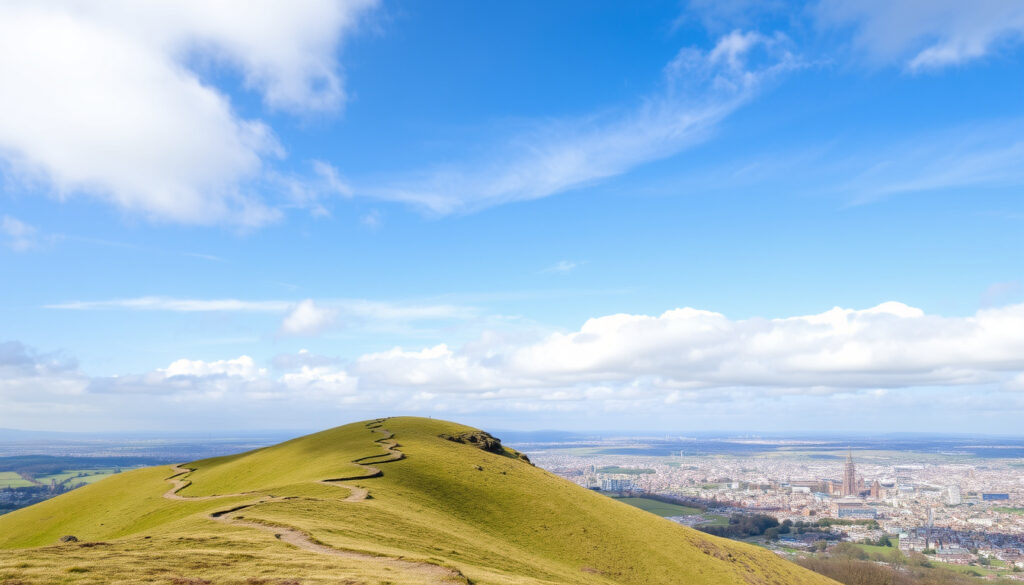
Arthurs Seat – Hiking Routes, Height And Visitor Guide
Arthur’s Seat, the ancient volcano at the heart of Edinburgh, is one of the UK’s most iconic urban hikes. Rising 251 metres above Holyrood Park, it offers panoramic views of the city and a chance to walk on geological history that is more than 340 million years old. This guide covers everything from the best routes and practical logistics to the fascinating stories behind its name.
Whether you are a first-time visitor or a local looking for a quick escape, the climb is manageable, free, and accessible year-round. The park’s central location means you can be at the summit within an hour of leaving Edinburgh’s Royal Mile.
Multiple trails suit different fitness levels, from a 20-minute scramble at Dunsapie Loch to a leisurely two-hour walk around the base via Piper’s Walk. Below, we answer the most common questions about this remarkable landmark.
Why Is It Called Arthur’s Seat and Who Was Arthur?
- Arthur’s Seat is the remnant of an extinct volcanic system that last erupted over 340 million years ago.
- The name may derive from the legend of King Arthur, but no definitive link exists; alternative theories include Gaelic etymology.
- It is one of the most popular urban hikes in the UK, attracting over 1 million visitors annually.
- The best views are from the summit at sunrise or sunset, though the park closes at dusk.
| Metric | Value |
|---|---|
| Height | 251 m (823 ft) |
| Prominence | approx 174 m |
| Country | Scotland |
| OS Grid Reference | NT275732 |
| Parent Peak | none (urban hill) |
| First ascent | unknown (ancient use) |
| Easiest route | Grassmarket path via Dunsapie Loch |
| Park opening hours | 24/7 (gates may close at night) |
The exact origin of the name ‘Arthur’s Seat’ remains uncertain. The most popular theory links it to the legendary King Arthur, but there is no direct historical evidence to confirm this connection. Some scholars suggest the name may come from the Scottish Gaelic ‘Àrd na Sean’, meaning ‘height of the arrow’, or ‘bear’s seat’ in Brythonic languages.
An alternative name, ‘The Lord’s Seat’, appears in some medieval documents, possibly referencing religious or aristocratic landownership. This adds another layer to the debate over the hill’s naming origin. The first written references to ‘Arthur’s Seat’ appear in the medieval period, centuries after the Arthurian legends became widespread.
In folklore, Arthur’s Seat has been linked to tales of sleeping knights and hidden treasures, themes common to many ancient hills across Britain. These stories, while not factual, helped preserve the name in local tradition.
Geologists and historians agree that the name’s connection to King Arthur is plausible but unproven. The Gaelic origin theory offers an alternative that does not rely on Arthurian legend. Both interpretations remain speculative.
How High Is Arthur’s Seat and How Long Does the Climb Take?
Height and Elevation
Arthur’s Seat stands 251 metres (823 feet) above sea level, though one source rounds it to 250 m (822 ft). This makes it the highest point in Holyrood Park, which covers approximately 650 acres. The hill is part of the same volcanic system that formed Edinburgh Castle Rock and Calton Hill, giving the city its distinctive skyline.
Climb Duration
Most guides place the hike at 1–3 hours round trip, depending on the route, fitness level, and time spent at the summit. The quickest ascent is from the Dunsapie Loch side, taking about 20–30 minutes on a steep grassy slope. The more popular beginner-friendly route from the Holyrood Palace / Queen’s Drive side takes 45–60 minutes up and 1.5–3 hours round trip.
Difficulty Level
The climb is usually described as moderate, with a steep final section and some rocky or grassy scrambling near the top. It is not considered highly accessible for mobility-impaired visitors because the terrain includes steep and uneven sections. The elevation gain is modest, but the steepness near the summit requires care.
How to Get to Arthur’s Seat and Best Routes to the Summit
Starting Points
The most common start is the Holyrood Palace / Queen’s Drive car park near the Scottish Parliament and Holyrood Visitor Centre. If walking from central Edinburgh, it is about a 15–20 minute walk from the Royal Mile or Princes Street area to the park entrance. Another option is parking near Dunsapie Loch for a shorter ascent, though free parking spaces along Queen’s Drive fill quickly on clear days.
Main Hiking Routes
The route from the Holyrood Palace side is the most common beginner-friendly approach, usually 45–60 minutes up. The Dunsapie Loch side is the quickest way up, taking about 20–30 minutes on a steep grassy slope. For a quieter experience, the Blue Route is a scenic walk taking roughly 1–2 hours, while the longer Piper’s Walk takes about 1h45–2h30. One source recommends a loop combining the summit with Salisbury Crags on the return.
Directions from the Royal Mile
From the Royal Mile, walk east toward Holyrood Palace and enter Holyrood Park there. A common approach is to start at the Queen’s Drive / Holyrood Palace end and follow the path curving around the base of Crow Hill before climbing the final rocky section. Another entry point mentioned is the Commonwealth Pool / Pollock Halls side for a different route into the park.
Download a trail map before visiting. Many guides recommend starting at the Commonwealth Pool side if you prefer a less crowded entry into the park during peak hours.
Is Arthur’s Seat a Volcano and Is It Safe to Visit?
Geological Background
Arthur’s Seat is widely described as the eroded remnant of an extinct volcano formed around 350 million years ago in the Carboniferous period. It is part of the same broad volcanic system as Edinburgh Castle Rock and Calton Hill. The hill’s dramatic shape comes from volcanic and later erosional processes, which is why it rises sharply above the surrounding city rather than forming a long mountain ridge.
Safety Considerations
The extinct volcano is not active and poses no volcanic threat. The main safety considerations are the steep, uneven terrain and weather conditions. The climb is moderate, with a steep final section requiring care on rocky or grassy scrambling paths. It is not considered highly accessible for mobility-impaired visitors. Early morning or late afternoon is often recommended for fewer crowds and better light.
Is Arthur’s Seat Open Year-Round and What Are the Best Times to Visit?
Multiple sources state Arthur’s Seat and Holyrood Park are open 24 hours a day, with no ticketing or gate closure. The park and hill are described as free, ungated, and open all year; no booking is required. One guide notes the summit is busiest between 10 am and 2 pm.
Best Time to Visit
Early morning or late afternoon is often recommended for fewer crowds and better light, especially for sunrise or sunset views. The summit offers stunning 360-degree views across Edinburgh, with the best visibility on clear days. Weekdays are generally quieter than weekends.
Timeline of Arthur’s Seat’s History
- Geological (340 million years ago): Volcanic eruption forms Arthur’s Seat.
- Iron Age (c. 2,000 years ago): Hillfort construction on summit.
- Medieval period: First written references to ‘Arthur’s Seat’.
- 18th–19th centuries: Quarrying, walking path development.
- 1920s: Part of Holyrood Park gifted to the nation.
- Present day: Popular tourist destination and protected landscape.
Myth vs. Fact: What We Know and What Remains Uncertain
| Established Information | Information That Remains Unclear |
|---|---|
| Arthur’s Seat is an extinct volcano. Rock types confirm ancient volcanic origin; last eruption ~340 million years ago. | The name refers to King Arthur. No direct evidence; may be derived from Scottish Gaelic ‘Àrd na Sean’ (height of the arrow) or other sources. |
| It is the highest point in Holyrood Park, Edinburgh. | It is the highest point in Edinburgh. This is contested by other hills within the city boundary. |
What Makes Arthur’s Seat Unique in Edinburgh?
Arthur’s Seat is one of the most accessible ancient volcanoes in the world, sitting within a 650-acre royal park just minutes from Edinburgh’s city centre. Unlike other urban hikes such as Table Mountain or Mount Royal, its scale is modest but its geological significance is immense, offering rare insights into Scotland’s volcanic past. The hill’s shape, formed by volcanic and erosional processes, provides a dramatic contrast to the surrounding flat cityscape.
The park’s 24-hour access and free entry make it unusually democratic for a major attraction. It attracts over 1 million visitors annually, drawn by the combination of natural history, urban convenience, and panoramic views. The site also holds archaeological significance, with evidence of Iron Age hillfort construction on the summit.
What Do the Experts Say About Arthur’s Seat?
“Dominated by the iconic Arthur’s Seat, this ancient volcanic site offers stunning views of the city and beyond.”
Historic Environment Scotland
“A hill for magnitude, a mountain in virtue of its bold design.”
Robert Louis Stevenson
“On a good day, you can expect breath-taking 360-degree views across Edinburgh from its summit.”
Regatta Walking Guide
Summary: Is Arthur’s Seat Worth the Climb?
Arthur’s Seat offers a uniquely accessible urban hike with extraordinary views, deep geological history, and a touch of Arthurian mystery. It is free, open year-round, and suitable for most fitness levels with preparation. For anyone visiting Edinburgh, it remains one of the city’s most rewarding experiences. For more on exploring Edinburgh’s green spaces, see our Holyrood Park Guide.
Frequently Asked Questions
Arthurs seat who is arthur?
The name ‘Arthur’ is likely linked to the legendary King Arthur, though some scholars suggest it may derive from Gaelic words meaning ‘height of the arrow’ or ‘bear’s seat’.
What is the lords seat?
‘The Lord’s Seat’ is an alternative name sometimes used for a formation on Arthur’s Seat, possibly referencing religious or aristocratic history.
What is Eagle Arthur’s Seat?
A rock formation or viewpoint on Arthur’s Seat, likely named for its eagle-like shape or historical eagle sightings in the area.
Arthurs Seat information
Arthur’s Seat is the main peak in Holyrood Park, Edinburgh. It stands 251 meters tall, is an ancient extinct volcano, and offers panoramic views of the city. The park is open year-round and entry is free.
How long does it take to climb Arthur’s Seat?
Most guides place the hike at 1–3 hours round trip, depending on the route, fitness level, and time spent at the summit. The quickest ascent is about 20–30 minutes via Dunsapie Loch.
Is Arthur’s Seat open in winter?
Yes, Arthur’s Seat and Holyrood Park are open 24 hours a day year-round. No booking is required, and entry is free. However, conditions can be icy and slippery in winter.
What should I bring for a hike up Arthur’s Seat?
Sturdy footwear with good grip is essential due to steep, uneven terrain. Bring water, weather-appropriate clothing, and a fully charged phone. Early morning or late afternoon visits offer fewer crowds.
Are there guided tours of Arthur’s Seat?
Yes, some companies offer guided walks around Holyrood Park and Arthur’s Seat. These tours often include geological and historical commentary. Check local tour operators for availability and schedules.
What are the best views from Arthur’s Seat?
The summit offers 360-degree views across Edinburgh, including the Old Town, Edinburgh Castle, Calton Hill, the Firth of Forth, and the Pentland Hills. Sunrise and sunset provide the best light for photography.
Is Arthur’s Seat suitable for children?
Children can enjoy the climb but should be supervised carefully, especially near the steep final section. The moderate difficulty and short duration make it a family-friendly option with proper preparation.
More related posts
 Hannah Waddingham – Age, Height, Husband & Game of Thrones
 Volodymyr Zelenskyy – Biography, Age, Wife, and More
 Derren Litten – Biography, Age, Husband and TV Shows
 Geraldine McEwan – English Actress and Miss Marple Star
 Alex Consani – Biography, Age, Height and Career
 Tom Hanks – Complete Biography Best Movies and Net Worth
 9 Stone in Pounds – Exact 126 lb Conversion Explained
 Bivol vs Beterbiev 2 – Date Location Results Fight Card
