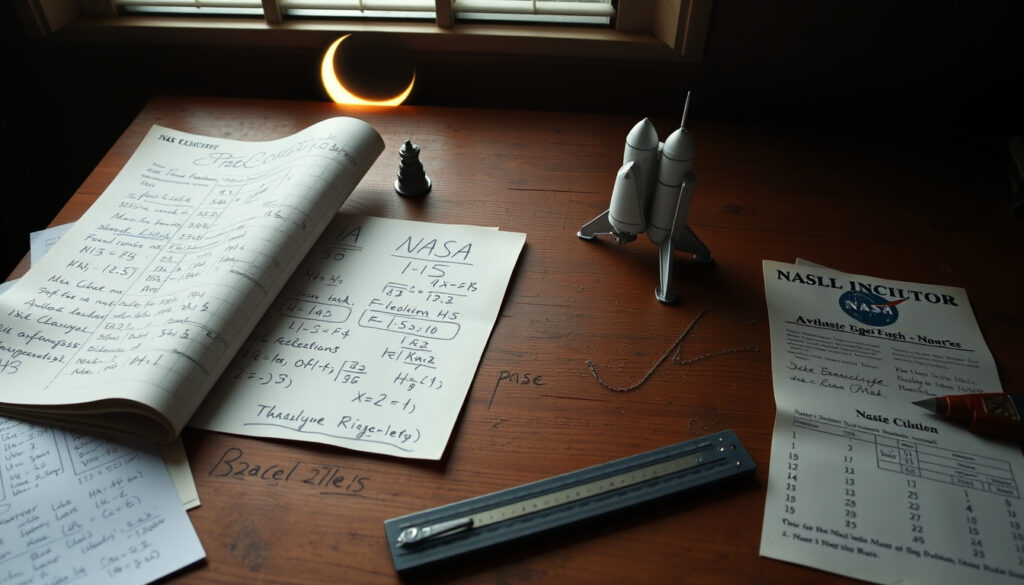
Katherine Johnson – The NASA Mathematician Who Helped Put a Man on the Moon
Katherine Johnson was a mathematician whose calculations at NASA helped send the first Americans to space and paved the way for landing on the Moon. Her work, largely unrecognized for decades, became widely known through the 2016 book and film Hidden Figures. Johnson’s story is one of intellectual brilliance, perseverance, and quiet determination in the face of systemic discrimination.
Born in 1918 in West Virginia, Johnson showed an early aptitude for mathematics. She graduated from college at 18 and began working at the National Advisory Committee for Aeronautics — the agency that would become NASA — in 1953. Over the next three decades, she became one of the most trusted mathematicians in the space program.
Johnson’s calculations were essential for missions including Alan Shepard’s first American flight, John Glenn’s orbital mission, and the Apollo 11 lunar landing. She retired in 1986 and received the Presidential Medal of Freedom in 2015, among many other honors. She died in 2020 at the age of 101.
Who Was Katherine Johnson and What Is She Famous For?
Born
August 26, 1918, White Sulphur Springs, WV
Died
February 24, 2020, Hampton, VA (Age 101)
Known For
Orbital mechanics calculations for NASA
Award
Presidential Medal of Freedom (2015)
- Katherine Johnson’s work was critical for the success of John Glenn’s Friendship 7 mission, the Mercury program, and Apollo 11.
- She was one of the African American “human computers” at NACA/NASA Langley Research Center.
- Her story was popularized in the 2016 book and film Hidden Figures.
- She calculated the trajectory for the 1969 Apollo 11 moon landing.
- She co-authored 26 scientific papers and was awarded the Presidential Medal of Freedom in 2015.
| Fact | Detail |
|---|---|
| Birth | August 26, 1918 |
| Death | February 24, 2020 |
| Age at death | 101 years old |
| Education | B.S. in Mathematics and French, West Virginia State College |
| Profession | Mathematician, “human computer” |
| Employer | NACA / NASA Langley Research Center |
| Famous for | Calculating orbital mechanics for Mercury, Apollo, and Space Shuttle missions |
| Award | Presidential Medal of Freedom (2015) |
| Media | Subject of Hidden Figures book (2016) and movie (2016) |
What Did Katherine Johnson Do at NASA?
Johnson joined the NACA Langley Research Center in June 1953 as a “human computer” — a person who performed complex mathematical calculations by hand. At the time, electronic computers were still new and not always reliable. Engineers depended on human computers like Johnson to verify data and produce accurate trajectories.
Project Mercury: Trajectories for the First American Astronauts
Johnson calculated the launch windows and return paths for the first U.S. crewed spaceflights. She worked on Alan Shepard’s Freedom 7 mission in 1961, the first American spaceflight, and later verified the orbital equations for John Glenn’s Friendship 7 mission in 1962. According to widely reported accounts, Glenn specifically asked for Johnson to check the numbers before he would fly.
Apollo 11: The Moon Landing
For the Apollo program, Johnson calculated the trajectory that would allow the lunar module to rendezvous with the command module after landing on the Moon. Her work helped ensure that astronauts could travel to the Moon and return safely to Earth. NASA credits her with making critical contributions to the success of Apollo 11.
Space Shuttle and Later Work
Johnson also contributed to the early planning of the Space Shuttle program. She co-authored 26 scientific papers during her career and retired in 1986 after 33 years of service.
When people search for “Katherine Johnson inventions,” it is important to clarify that her contributions were mathematical, not physical. She developed formulas and calculation methods for orbital mechanics — the equations that describe how spacecraft move through space. These are sometimes described as “inventive calculations” or “mathematical breakthroughs.” She did not patent devices or build hardware.
Before digital computers became reliable, NASA employed a pool of women mathematicians to perform calculations by hand. These “human computers” checked each other’s work and provided the data that engineers and astronauts trusted. Johnson was one of the most skilled and respected members of this team at Langley Research Center.
Is the “Hidden Figures” Movie Accurate About Katherine Johnson?
The 2016 film Hidden Figures, starring Taraji P. Henson as Katherine Johnson, brought her story to millions of viewers worldwide. The film is broadly accurate in its portrayal of Johnson’s role at NASA and the discrimination she faced, but it takes some creative liberties for dramatic effect.
What the Film Gets Right
The film accurately depicts Johnson’s work calculating trajectories for John Glenn’s mission and her position as a Black woman in a segregated workplace. The core events — including Glenn’s request that Johnson verify the numbers — are historically documented. The film also correctly shows that Johnson had to use a separate bathroom and coffee pot because of segregation.
What the Film Changes or Condenses
Some scenes in the film are dramatized or compressed. For example, the scene where Johnson runs calculations with a COBOL computer is a simplification. The timeline of events in the film is also condensed, and certain characters are composites of real people. The book Hidden Figures by Margot Lee Shetterly provides a more detailed and historically precise account of Johnson’s life and the broader group of women mathematicians at NASA.
The Book vs. The Film
The book Hidden Figures: The American Dream and the Untold Story of the Black Women Mathematicians Who Helped Win the Space Race, published in 2016, covers a wider range of characters and includes more detail about the scientific and social context. The film focuses more narrowly on Johnson, Dorothy Vaughan, and Mary Jackson. Both the book and the film are credited with bringing Johnson’s contributions to public attention.
Hidden Figures is a Hollywood drama, not a documentary. While it is based on real events, some scenes are invented or altered for storytelling. Readers seeking a fully factual account should consult the original book by Margot Lee Shetterly, NASA’s official biographies, and Johnson’s oral history interviews.
What Are the Most Famous Katherine Johnson Quotes?
Johnson’s words reflect her lifelong passion for mathematics and her quiet confidence. Several of her quotes have been widely shared in tributes and educational materials.
“We will always have STEM with us. Some things will drop out of the public eye and will go away, but there will always be science, engineering, and technology. And there will always, always be mathematics.”
— Katherine Johnson, as quoted in eulogies and NASA tributes
“I counted everything. I counted the steps to the road, the steps up to church, the number of dishes and silverware I washed… anything that could be counted, I did.”
— Katherine Johnson on her childhood, often cited in biographies
“Get the girl to check the numbers. If she says they’re good, I’m ready to go.”
— John Glenn, referring to Katherine Johnson before Friendship 7 (widely reported)
When Did Katherine Johnson’s Key Milestones Occur?
- 1918 — Born Creola Katherine Coleman in White Sulphur Springs, West Virginia.
- 1937 — Graduated summa cum laude from West Virginia State College (now University) at age 18.
- 1953 — Started working at the NACA (later NASA) Langley Research Center as a “human computer.”
- 1961 — Calculated the trajectory for Alan Shepard’s Freedom 7 mission, the first American in space.
- 1962 — Verified the orbital equations for John Glenn’s Friendship 7 mission; Glenn refused to fly unless Johnson checked the numbers.
- 1969 — Calculated the trajectory for the Apollo 11 moon landing.
- 1986 — Retired from NASA after 33 years of service.
- 2015 — Awarded the Presidential Medal of Freedom by President Barack Obama.
- 2016 — The book and film Hidden Figures are released, bringing her story to global prominence.
- 2020 — Died at age 101 in Hampton, Virginia.
What Facts About Katherine Johnson Are Established and What Remains Unclear?
| Established Information | Information That Remains Unclear |
|---|---|
| Katherine Johnson was a mathematician at NASA Langley Research Center. | The exact degree of creative liberty taken in the Hidden Figures movie. The film dramatizes some events (e.g., the scene with the COBOL computer). The book is a more detailed historical account, but still narrative. |
| She performed critical calculations for the Mercury, Apollo, and Space Shuttle missions. | The specific classification of “inventions” — Johnson is more accurately described as making mathematical breakthroughs and inventive calculations rather than inventing physical objects. The term “inventions” in search queries likely refers to her mathematical methods and orbital trajectory formulas. |
| She was awarded the Presidential Medal of Freedom in 2015. | The full extent of contributions by the entire team of “human computers” at NASA is still being researched. |
| She was born on August 26, 1918, and died on February 24, 2020. | Some details of her personal life, including her early marriage and family background, are less documented than her NASA career. |
| She co-authored 26 scientific papers. | — |
What Was the Broader Context of Katherine Johnson’s Work?
Johnson’s career unfolded during the height of the Space Race between the United States and the Soviet Union. The 1950s and 1960s were a period of intense competition in space exploration, and NASA needed the best minds available to solve complex mathematical problems. At the same time, segregation and racial discrimination were still legal in many parts of the United States, and women — especially Black women — faced significant barriers to professional advancement.
Johnson worked in a segregated environment at Langley. She and her Black colleagues were assigned to separate offices and dining areas. Despite these conditions, Johnson’s mathematical ability earned her respect and increasing responsibility. Her career is an example of the intersection of the Space Race and the Civil Rights Movement. She was not only a scientist but also a person who helped break down racial and gender barriers in STEM fields.
The “human computer” role itself is historically significant. Before digital computers became reliable, human mathematicians performed the calculations that made spaceflight possible. Johnson and her colleagues provided the data that engineers, astronauts, and mission controllers trusted. The Hidden Figures book and film brought this history to a wide audience and inspired a new generation of students to pursue careers in science and mathematics.
Where Can You Find Reliable Information About Katherine Johnson?
The most authoritative sources for Johnson’s life and work include NASA’s official biography, the White House announcement of her Presidential Medal of Freedom, and the Wikipedia article, which is regularly updated and cited. The Katherine Johnson Foundation also maintains an official website dedicated to preserving her legacy and promoting STEM education.
“We will always have STEM with us. Some things will drop out of the public eye and will go away, but there will always be science, engineering, and technology. And there will always, always be mathematics.”
— Katherine Johnson, as quoted in eulogies and NASA tributes
“I counted everything. I counted the steps to the road, the steps up to church, the number of dishes and silverware I washed… anything that could be counted, I did.”
— Katherine Johnson on her childhood, often cited in biographies
What Is Katherine Johnson’s Enduring Legacy?
Katherine Johnson’s legacy is both scientific and cultural. Her calculations helped make human spaceflight possible, and her story has become a symbol of the contributions of women and minorities to science and technology. The Katherine Johnson Foundation continues to promote STEM education, and NASA has named a research facility in her honor. Her life demonstrates that talent and perseverance can overcome even the most entrenched barriers. Learn more about NASA’s history of human computers.
Frequently Asked Questions About Katherine Johnson
What book is about Katherine Johnson?
The most famous book is Hidden Figures: The American Dream and the Untold Story of the Black Women Mathematicians Who Helped Win the Space Race by Margot Lee Shetterly (2016). There is also a young readers’ edition and a children’s picture book titled Counting on Katherine.
Who was Katherine Johnson’s husband?
Katherine Johnson married James A. Johnson, an Army officer and later a teacher, in 1959. They were married until his death in 2019.
What awards did Katherine Johnson win?
Her most notable award is the Presidential Medal of Freedom (2015). She also received the Congressional Gold Medal (2019), an honorary doctorate from West Virginia State University, and NASA’s Silver Snoopy award, among others.
How old was Katherine Johnson when she died?
She was 101 years old. She died on February 24, 2020.
What did Katherine Johnson study in college?
She studied Mathematics and French at West Virginia State College, graduating summa cum laude.
How did Katherine Johnson contribute to the Apollo 11 mission?
She calculated the trajectory that would allow the lunar module to rendezvous with the command module after landing on the Moon. Her work helped ensure the astronauts could return safely to Earth.
What does “human computer” mean?
Before digital computers became reliable, NASA employed mathematicians — mostly women — to perform complex calculations by hand. These workers were called “human computers,” and they were essential for verifying data and producing accurate trajectories.
Is the Hidden Figures movie accurate?
The film is broadly accurate but takes some creative liberties for dramatic effect. The book by Margot Lee Shetterly provides a more detailed historical account. Key events, such as John Glenn’s request for Johnson to verify the numbers, are historically documented.
What was Katherine Johnson’s full name?
Her full name was Creola Katherine Johnson, née Coleman, previously Goble.
Where did Katherine Johnson go to college?
She attended West Virginia State College (now West Virginia State University), where she earned a B.S. in Mathematics and French in 1937.
More related posts
 Tinker Bell – The Complete Guide to Disney’s Iconic Fairy
 Nick Clegg – Career Timeline, Meta Exit, and New Venture
 Boxers Ring – Complete Buying Guide with Sizes and Prices
 Harry Hamlin – Biography, Net Worth, and Mad Men Role
 Karen Mulder – 2026 Comeback, Vogue Cover and Allegations
 Premier League Transfer News – Latest Done Deals and Updates
 Jamie Murray – Biography, Grand Slams, Retirement and Family Life
 The Super Mario Galaxy Movie – Release Date, Cast & Everything We Know
