Area of a Cylinder – Formula, Examples and Practice Tips
Understanding the area of a cylinder is essential for geometry students, engineers, and anyone working with cylindrical objects such as cans, pipes, or tanks. While the term “area of a cylinder” often refers to its surface area, there are distinct formulas for different parts of the shape. This guide breaks down the formulas, explains step-by-step calculations, and provides practice tips for GCSE and beyond.
A cylinder consists of two identical circular bases and a curved side that connects them. To find its total surface area, you must add the areas of both bases to the area of the curved side. The formulas are straightforward once you understand the components involved.
This article covers every aspect of cylinder area calculations, from basic formulas to advanced problem-solving techniques, including when you only know the diameter or the volume and height.
What is the formula for the area of a cylinder?
Sum of areas of two circular bases and curved surface
Area of the side (lateral) = 2πrh
Area of one circular base = πr²
TSA = 2πr² + 2πrh; CSA = 2πrh
The cylinder area depends on two measurements: the radius (r) of the circular base and the height (h) of the cylinder. If you know the diameter, divide it by 2 to get the radius before using the standard formulas. The curved surface area is also called the lateral surface area.
- The cylinder area depends on radius and height; diameter is twice radius.
- Curved surface area is often called lateral surface area.
- For a cylinder without a lid, total area = curved area + one base.
- Volume-based area calculation requires solving for radius first using V = πr²h.
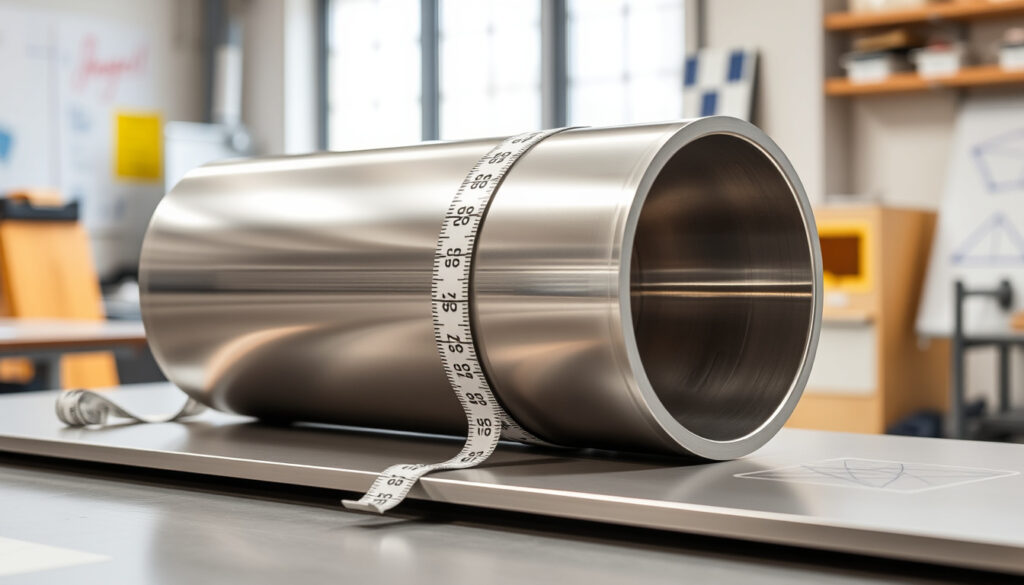
- The curved side “unrolls” into a rectangle with height h and length equal to the circumference (2πr).
- Always check whether the problem asks for total surface area or just the curved part.
- If given the diameter, convert it to radius before applying formulas.
| Property | Formula | Units |
|---|---|---|
| Curved Surface Area | 2πrh | square units |
| Base Area (each) | πr² | square units |
| Total Surface Area | 2πr² + 2πrh | square units |
| Volume | πr²h | cubic units |
| Total Surface Area using diameter | πd²/2 + πdh | square units |
| Curved Surface Area using diameter | πdh | square units |
How do you calculate the surface area of a cylinder?
How to calculate the area of a cylinder using diameter
When a problem gives the diameter instead of the radius, the first step is to convert: r = d/2. The curved surface area can then be written as πdh because d = 2r. For total surface area, use TSA = 2π(d/2)² + 2π(d/2)h = πd²/2 + πdh. This approach is commonly seen in GCSE and textbook exercises.
If you need curved surface area and have the diameter, you can skip converting to radius and directly use CSA = πdh. This saves a step and reduces calculation errors.
How to find the area of a cylinder given the volume and height
If you know the volume V and height h, you can find the radius by rearranging the volume formula: V = πr²h gives r = √(V / (πh)). Once you have the radius, plug it into the surface area formulas. This method only works if the cylinder has a consistent cross-section and the volume is known.
How do you use a cylinder area calculator?
Online calculators simplify the process by letting you input radius and height (or diameter and height) and instantly returning curved and total surface areas. Some calculators also handle volume and missing dimensions. While calculators are convenient, it is important to understand the underlying formulas to avoid misinterpreting results.
How to solve cylinder area problems for GCSE?
GCSE exams frequently include cylinder area questions. The key steps are: identify whether the question asks for volume, curved surface area, or total surface area; convert the diameter to radius if needed; then substitute into the correct formula. Practice problems often mix radius and diameter, so reading carefully is essential.
What is the difference between lateral and total surface area?
The lateral surface area (curved surface area) covers only the side of the cylinder – 2πrh. The total surface area adds the two circular bases: 2πr² + 2πrh. Many real-world questions specify whether to include the ends. For example, a can of soup uses total surface area, while a pipe might only need the curved surface.
A frequent error in GCSE questions is forgetting the “2” in front of πr² for total surface area. Always count the number of bases – a closed cylinder has two, while an open cylinder has one or none.
Where can I find practice worksheets for cylinder area?
Several trusted sources offer free practice materials. Corbettmaths cylinder area worksheet (PDF) contains a range of problems suitable for GCSE foundation and higher tiers. Third Space Learning: Surface area of a cylinder (GCSE) provides step-by-step worked examples with exam tips. Byju’s: Surface area of a cylinder includes derivation and examples for additional reinforcement.
Some problems describe a cylinder with one or both ends missing, such as a water tank with an open top. For those, total surface area is curved area plus the number of bases present (1 or 0). Always read the question to see if “closed” or “open” is specified.
How were cylinder area formulas developed over time?
The study of cylinder geometry dates back to ancient Greece. The mathematician Archimedes (c. 287–212 BCE) wrote extensively on spheres and cylinders, proving relationships between their volumes and surface areas. His work “On the Sphere and Cylinder” established formulas that are still taught today. Over centuries, these formulas were refined and standardized in modern mathematics education, becoming a staple of geometry curricula worldwide.
- c. 225 BCE – Archimedes publishes “On the Sphere and Cylinder”, demonstrating that the surface area of a cylinder (excluding bases) equals the area of a circle with the same radius times the height.
- 10th century – Islamic mathematicians like Al-Biruni further develop geometric methods for calculating volumes and areas.
- 17th century – Calculus provides a rigorous framework for deriving surface area formulas via integration.
- 19th century – Standardized mathematics textbooks spread the formulas across Europe and America.
- 20th century – The formulas become core content in secondary mathematics, including GCSE syllabi in the UK.
What should you watch out for when calculating cylinder area?
Several points of confusion can lead to errors. The table below clarifies what is well established and what remains ambiguous in typical problems.
| Established information | Information that remains unclear |
|---|---|
| The term “area of a cylinder” almost always means surface area, not cross-sectional area. | Some problems may use “area” to mean the area of the curved surface only – context matters. |
| Always use radius in the standard formulas; if given diameter, divide by 2. | Whether to include one or two bases is often left unstated – rely on real-world context. |
| If given volume and height, radius is determined uniquely (positive root). | When a cylinder is not closed, the formula for total area changes, but the problem may not explicitly say “open”. |
Why does understanding cylinder area matter in real life?
Cylinders appear everywhere: beverage cans, pipes, storage tanks, and even architectural columns. Knowing how to calculate surface area helps in estimating material costs (e.g., paint or metal sheeting), designing packaging, and solving engineering problems. For students, mastering these formulas builds a foundation for more advanced geometry and trigonometry.
The ability to distinguish between curved and total surface area is particularly useful. For instance, when insulating a water heater, you only need the curved area; when wrapping a cylindrical gift, you need the total area including the top and bottom.
Which resources can help you master cylinder area calculations?
Several authoritative online resources provide clear explanations and exercises. Below are some of the most helpful.
“A useful way to remember the geometry is that the curved surface of a cylinder ‘unrolls’ into a rectangle, whose width is the height and whose length is the circumference of the base.”
– Helpingwithmath.com
BBC Bitesize: Surface area and volume of a cylinder offers a visual, step-by-step guide suitable for KS3 and GCSE revision. surface area of a cylinder provides a complete breakdown with diagrams and worked examples. For additional formula references, check study.com’s cylinder area page and this video tutorial on YouTube that walks through diameter-based calculations.
What is the key takeaway about the area of a cylinder?
The area of a cylinder is a fundamental geometric concept with practical applications. Remember the two main formulas: curved surface area = 2πrh and total surface area = 2πr² + 2πrh. Always check whether the problem requires curved or total area, and convert diameter to radius if needed. With practice, these calculations become straightforward. For more detail, see our article on cylinder area formulas.
Frequently Asked Questions
What is the difference between surface area and volume of a cylinder?
Surface area measures the total area of the outer surfaces, while volume measures the space inside the cylinder. They use different formulas and units (square vs cubic).
Can I calculate area of cylinder if I only have the diameter?
Yes, divide diameter by 2 to get radius, then use the standard formulas. Alternatively, use adapted formulas: CSA = πdh, TSA = πd²/2 + πdh.
What is the formula for area of a cylinder with diameter?
Total surface area = πd²/2 + πdh. Curved surface area = πdh. These are derived by substituting r = d/2 into the standard formulas.
Where can I find cylinder area worksheets?
Corbettmaths offers a free PDF worksheet; also check BBC Bitesize and Third Space Learning for structured practice with solutions.
How do I know whether to use curved or total surface area?
Read the problem carefully. If it mentions “lateral area” or “side only”, use curved. If it says “surface area” and the object is closed, use total. Real-world context also helps.
What is the curved surface area of a cylinder?
The curved surface area is the area of the side, excluding the top and bottom. Its formula is 2πrh (or πdh if using diameter).
How do you find the area of a cylinder without the top?
For an open cylinder, total area = curved area + one base = 2πrh + πr². If both ends are open, use only 2πrh.
What units are used for surface area of a cylinder?
Surface area is measured in square units, such as cm², m², or in². Corresponding to the units used for radius and height.
More related posts
 Samantha Beckinsale – Biography, Age, Career and Advocacy
 Jonny Evans – Career, Retirement and Legacy at Manchester United
 Boxers Ring – Complete Buying Guide with Sizes and Prices
 Fara Williams – Career, Personal Life, and Arsenal Legacy
 Women’s Shirt Guide – UK Brands, Sales and White Styles
 Fra Fee – Actor, Les Misérables and Hawkeye Star
 Omari Hutchinson – Biography and Career Profile
 Ernest Shackleton – Endurance Expedition, Death and Legacy
