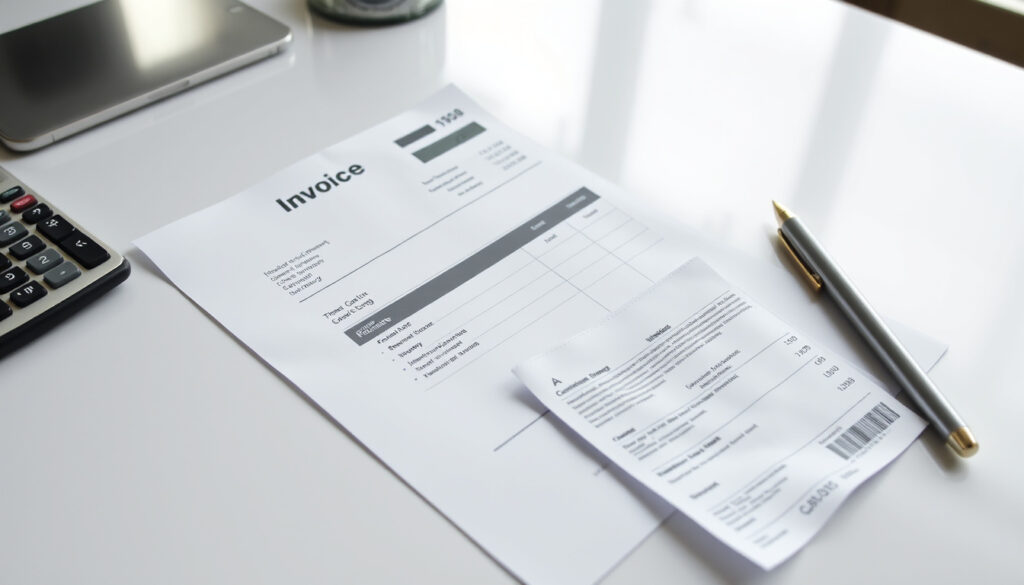
What Is an Invoice – Definition, Examples, vs Receipt
An invoice is a commercial document a seller issues to a buyer to request payment for goods or services. Usually sent after delivery or completion of work, it itemizes charges, payment terms, and the total amount due. In accounting, an invoice records what was sold, to whom, when, for how much, and by when payment is expected.
For businesses, invoices are essential tools. They support accounts receivable for the seller and accounts payable for the buyer. Without them, tracking revenue, managing cash flow, and preparing tax filings become significantly harder. A receipt, by contrast, is issued only after payment and serves as proof that the buyer has settled the debt.
Understanding invoices matters for anyone running a business, freelancing, or handling company finances. The difference between an invoice and a receipt is one of the most common points of confusion among new business owners, yet it is fundamental to proper financial record-keeping.
What is an Invoice? Definition and Core Purpose
- Definition: a commercial document requesting payment for goods or services.
- Key parts: invoice number, date, seller/buyer info, itemized list, total amount, payment terms.
- Common types: pro forma, recurring, credit memo, commercial invoice.
- Vs receipt: invoice is sent before payment, receipt after payment.
- Invoices are legally enforceable documents in many jurisdictions.
- Modern invoicing is increasingly digital, enabling automation and faster payments.
- Understanding invoice components helps avoid payment disputes.
- Invoice vs receipt confusion is the most common question among new business owners.
- An invoice serves as primary evidence for audits and tax filings.
- Different industries have specific invoice requirements, such as construction progress invoices.
- The shift to electronic invoicing reduces errors and speeds up payment cycles.
| Field | Details |
|---|---|
| Definition | Formal payment request |
| Sent | After delivery but before payment |
| Purpose | Accounting, legal record, tax |
| Key fields | Invoice number, date, due date, line items |
| Types | Pro forma, credit memo, recurring |
| Related | Receipt, bill, statement |
| Legal status | Evidence of a billing claim; effect depends on contract and jurisdiction |
| Payment terms | Net 30, due on receipt, 2/10 Net 30 |
| Tax details | VAT number, VAT amount, total excluding and including VAT |
| Format | Paper, PDF, electronic, automated cloud |
Invoice vs Receipt: Key Differences
The most frequent question people ask about invoices is how they differ from receipts. The two documents serve different purposes and appear at different stages of a transaction.
What is a receipt?
A receipt is issued after payment and serves as proof that the buyer has paid. It confirms settlement of the debt that the invoice originally detailed. In accounting records, a receipt supports the proof of settlement after payment, while an invoice supports accounts receivable for the seller and accounts payable for the buyer.
What is an invoice vs receipt?
The core difference lies in timing and purpose. An invoice is sent before payment is made or due, and it requests payment while detailing the debt owed. A receipt is sent after payment and confirms that payment was received. Invoices are used for billing, collections, and accounting records. Receipts serve as proof of payment and support tax record-keeping.
Invoice: sent before payment, requests payment, used for accounts receivable. Receipt: sent after payment, confirms payment, used for proof of settlement. This distinction is fundamental to accurate bookkeeping.
| Item | Invoice | Receipt |
|---|---|---|
| Timing | Before payment is made or due | After payment is made |
| Purpose | Requests payment and details the debt owed | Confirms payment was received |
| Typical use | Billing, collections, accounting records | Proof of payment, record-keeping, tax support |
Real-World Examples and Invoice Templates
What is an invoice example?
A practical example makes the concept clear. Consider Invoice #INV-1042, issued on 28 May 2026, from ABC Ltd to XYZ Ltd, for website design services. It lists 10 hours at £80 per hour, a subtotal of £800, VAT of £160, and a total of £960, with payment due Net 30. This example includes all standard components: seller and buyer details, invoice number, date, itemized line items, totals, and payment terms.
What is an invoice template?
An invoice template is a pre-formatted document that includes all the required fields. Standard templates typically contain spaces for the invoice title, unique invoice number, seller and buyer details, invoice date and supply date, line items with quantities and unit prices, payment terms and due date, payment instructions, and tax details where applicable. For UK businesses, a VAT-registered template must also include the VAT number, VAT amount or rate, and totals excluding and including VAT.
How Invoicing Works: Payment, Terms, and Process
What is an invoice payment?
An invoice payment is the transfer of funds from the buyer to the seller in settlement of the amount stated on the invoice. The payment process begins when the seller issues the invoice and ends when the buyer pays the full amount by the due date. Payment can be made by bank transfer, credit card, cheque, or through an online payment portal, depending on the payment instructions provided on the invoice.
What is an invoice and how does it work in practice?
The invoicing process follows a clear sequence. A seller delivers goods or completes a service, then issues an invoice detailing what was provided, the amount due, and the payment terms. The buyer receives the invoice, records it in accounts payable, and processes payment according to the terms. Once payment is made, the seller issues a receipt as proof of settlement. Both documents are retained for accounting and tax purposes.
Net 30 means payment is due 30 days after the invoice date. Due on receipt expects immediate payment. 2/10 Net 30 offers a 2% discount if paid within 10 days, otherwise full payment is due in 30 days. Late fees may apply if payment is overdue.
What is an invoice uk?
For UK businesses, invoices commonly need the supplier’s and customer’s names and addresses, a unique invoice number, the invoice date, a clear description of the supply, amounts charged, and payment terms. If the business is VAT registered, the invoice should include the VAT number, the VAT amount or VAT rate as applicable, and the total amount excluding and including VAT. UK businesses often distinguish between a normal invoice and a VAT invoice when VAT must be shown for tax compliance.
For VAT-registered UK businesses, an invoice must include the VAT number, VAT amount or rate, and totals excluding and including VAT. Missing these details can lead to compliance issues with HMRC.
How Has Invoicing Evolved Throughout History?
Invoicing has changed dramatically over centuries, moving from physical records to digital automation.
- Ancient times: clay tablets were used as invoices to record transactions.
- Industrial revolution: printed invoices became standard as businesses scaled and needed formal billing.
- 1970s: computer-generated invoices appeared, reducing manual effort and errors.
- 2000s: email and PDF invoices became common, enabling faster delivery and lower costs.
- 2020s: automated cloud invoicing and e-invoicing mandates have transformed the landscape, with real-time payment and blockchain emerging as future trends.
What Is Known and Unknown About Invoices?
| Established information | Information that remains unclear |
|---|---|
| Invoices are used for payment requests and accounting. | Whether a verbal agreement invoice holds legal weight varies by country. |
| An invoice must include specific details to be valid, depending on jurisdiction. | The exact format of an invoice can vary widely across industries and regions. |
| An invoice is not the same as a receipt or a bill of lading. | The legal enforceability of an invoice depends on the underlying contract and governing law. |
| Invoices serve as primary documents for audits and tax filings. | Whether invoice terms are binding depends on whether both parties agreed to them. |
Why Are Invoices Important in Business?
Invoices are central to business cash flow and financial record-keeping. They serve as primary documents for audits and tax filings, providing a clear trail of revenue and outstanding payments. Different industries have specific invoice requirements, such as construction progress invoices that bill for completed stages of work, and medical invoices that must comply with healthcare regulations.
The shift to electronic invoicing reduces errors and speeds up payment cycles. Automated invoicing systems can send reminders, match payments, and reconcile accounts, freeing up time for business owners and finance teams. Invoices are not just billing tools; they are foundational to financial transparency and accountability.
What Do Authoritative Sources Say About Invoices?
“An invoice is a time-stamped commercial document that itemizes and records a transaction.”
Investopedia
“An invoice is a formal request for payment for the goods or services you’ve provided.”
HSBC UK
“Invoices are accounting documents that outline exactly what a customer owes.”
Adobe
What Is the Key Takeaway About Invoices?
An invoice is a fundamental business document that requests payment, records transaction details, and supports accounting and tax compliance. Knowing the difference between an invoice and a receipt, understanding the required components, and following proper payment terms are essential skills for any business owner. For a deeper comparison, see Invoice vs Receipt: Key Differences and explore What is an Invoice? Definition, Types & Components.
Frequently Asked Questions About Invoices
What is an invoice uk?
For UK businesses, invoices need the supplier and customer names and addresses, a unique invoice number, the invoice date, a description of the supply, amounts, and payment terms. VAT-registered businesses must also show the VAT number, VAT amount, and totals excluding and including VAT.
What is an invoice in amazon?
An Amazon invoice includes the same core elements as any standard invoice: seller and buyer details, invoice number, date, item descriptions, totals, and payment terms. For VAT-registered UK sellers on Amazon Marketplace, VAT fields are especially important for compliance.
What is an accounting ledger?
An accounting ledger is a book or digital record where all financial transactions are recorded. Invoices feed into ledgers as accounts receivable entries for the seller and accounts payable entries for the buyer.
What is a bill of quantities?
A bill of quantities is a document used in construction that lists all materials, labor, and costs for a project. It differs from an invoice, which requests payment for work already completed.
What is bill of materials?
A bill of materials is a list of raw materials, components, and assemblies needed to manufacture a product. It is used in production planning, not for requesting payment like an invoice.
What is mate receipt?
A mate receipt is a document issued by a ship’s officer acknowledging that goods have been loaded onto a vessel. It is used in shipping and is distinct from an invoice, which is a payment request.
More related posts
 How to Share Location on WhatsApp – Android iOS Web Guide
 Luke O’Nien – Biography, Career Stats and Personal Life
 Integrated Fridge Freezer – Complete UK Buying Guide 2025
 Steve Parish – The Football Chairman and the Grateful Dead Photographer
 Ayra Starr – Age, Real Name, Net Worth and Songs
 Jack Bannon – English and American Actors Explained
 Nadine Coyle – Biography, Relationships and 2025 Update
 Amanda Redman – Biography, Career and Best-Known Roles
