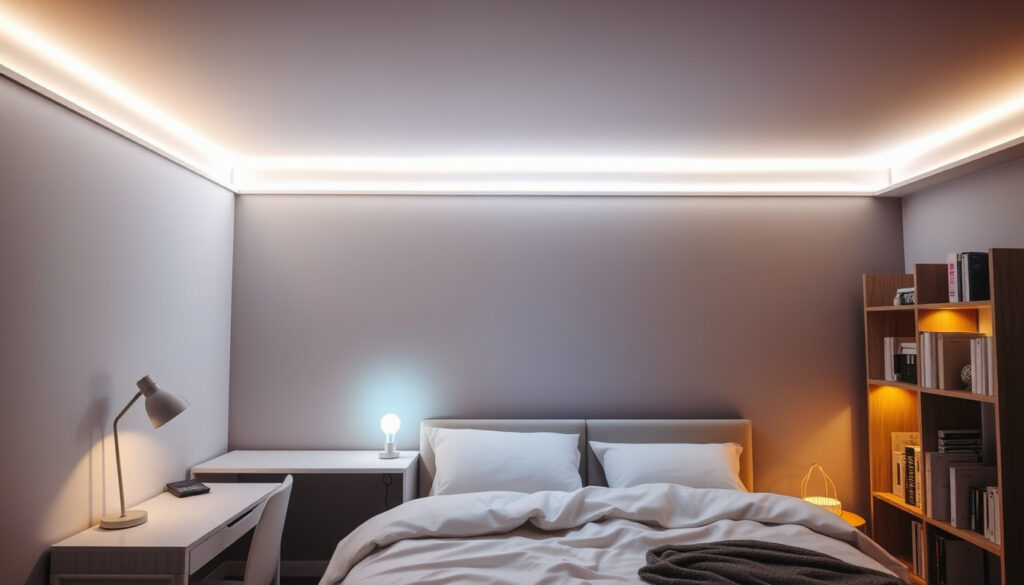
LED Lights for Bedroom – How to Choose the Right Setup
Choosing LED lights for a bedroom involves balancing comfort, visibility, and personal style. Unlike other rooms, a bedroom must support both relaxation and alertness depending on the time of day. The right lighting setup can make that transition easier.
Common options include warm white dimmable lights for winding down, cool white or tunable white for tasks, and RGB strips for accent effects. Each type serves a different purpose, and a layered combination often delivers the best results.
This article looks at color temperature, brightness levels, strip lengths, installation methods, and safety, drawing on several practical lighting sources to help you make an informed choice.
Which Colors and Color Temperatures Are Best for Bedroom LED Lights?
| Types | Lengths | Colors | Brightness |
|---|---|---|---|
| LED strip lights, Ceiling lights, Plug-in lights, Wall lights | 5m, 10m, 20m, 30m – choose based on room perimeter | Warm white (2700-3000K) for relaxation, Cool white (4000-5000K) for reading, RGB for mood | 400-800 lumens for ambient, 1000+ lumens for task, Dimmable recommended |
- Warm white (2700-3000K) is the most common choice for bedrooms because it supports relaxation.
- Lumens per square foot: 10-20 lumens/sq ft for ambient light; 30-50 for reading areas.
- LED strip lights operate at low voltage (12V/24V) and are generally safe for bedrooms when installed correctly.
- Plug-in lights are a practical option for renters or rooms without ceiling fixtures.
- Strip length is determined by the room’s perimeter, minus door and window widths.
| Factor | Detail |
|---|---|
| Bedroom size (example) | 10×12 ft (120 sq ft) |
| Recommended total lumens | 1200-2400 lumens |
| Strip length for perimeter | ~15-20m for an average room |
| Typical price range | $10-$50 for basic strips, $30-$100 for smart/dimmable |
| Common color temperatures | 2700K (warm), 3000K (soft warm), 4000K (neutral) |
| Energy savings | LED uses 80% less energy than incandescent |
How Many Lumens Do You Need for Bedroom Lighting?
Understanding Brightness for Different Zones
General bedroom lighting often benefits from roughly 1,500–3,000 lumens for ambient coverage, according to one guide. This provides a soft, even light suitable for most spaces.
For task lighting such as reading or dressing, 400–800 lumens per bulb is suggested. Accent lighting, used to highlight specific areas or objects, usually requires 200–400 lumens per bulb.
The Role of Dimmable Lights
A home-lighting guide notes bedroom lighting is typically comfortable at about 50–150 lux overall, with task lighting up to around 400 lux. Dimmable LEDs allow users to adjust brightness levels to match these varying needs.
A home-lighting guide suggests bedroom lighting is typically comfortable at about 50–150 lux overall, with task lighting up to around 400 lux. Matching brightness to activity helps create the right atmosphere for rest or focus.
What Length of LED Strip Lights Should You Buy for Your Bedroom?
Measuring Your Space
Strip lights should be selected by measuring the exact run you need. Only trim at marked cut points to avoid damaging the circuit. Common bedroom uses include ceiling perimeter cove lighting, under-bed strips, behind the headboard, along shelves, and inside closets.
Common Configurations
For an average bedroom, a 15–20 meter strip is often enough to cover the perimeter. Longer ceiling-strip setups can create immersive ambient effects; one example highlighted a 100 ft RGB ceiling-strip setup for large perimeter coverage.
For powered strip systems, the power supply must be correctly sized. One guide recommends using a supply with capacity at least 20% above the load requirement, or equivalently keeping the LED load under 80% of the supply’s maximum rating.
Where and How to Install LED Lights in a Bedroom
Ceiling Perimeter Cove Lighting
This method involves attaching strips around the edge of the ceiling to create a soft, indirect glow. It works well with aluminum mounting channels, which can improve heat management and installation stability.
Under-Bed and Behind Headboard
Placing strips under the bed or behind a headboard adds depth and a floating effect. It is a popular choice for modern, minimal bedroom designs.
Essential Tools and Steps
Instructions from manufacturers emphasize reading the guide, preparing a clean surface, and using secure mounting hardware. Plug-in versions offer easier DIY setup, while hardwired options provide a cleaner, permanent finish.
Plug-In vs Hardwired: Which Type of LED Light Is Better for a Bedroom?
Plug-in lights connect directly to a power outlet, making them ideal for renters or rooms without existing ceiling fixtures. They are easier to install and remove, but the cords may need to be managed for a tidy look.
Hardwired lights are integrated directly into the room’s electrical system. They offer a seamless appearance and are often used for ceiling fixtures or fixed wall lights. The choice between the two typically depends on whether you prioritize easy installation or a permanent finish.
Are LED Strip Lights Safe for Bedroom Use?
| Established Information | Remaining Considerations |
|---|---|
| LED strip lights are considered safe for bedrooms when properly installed on a clean, stable surface and connected to a suitable power source. | Exact lumens preference varies by individual and room layout. |
| Mounting strips in aluminum channels can improve heat management and installation stability. | Some users prefer cool white for a modern look, which may not suit everyone. |
| A dimmable LED strip offers flexible ambiance from bright task light to soft ambient light. | Installation difficulty depends on surface type and power source availability. |
For bed-frame or integrated lighting, always read the manufacturer’s guide, prepare the surface, and use secure mounting hardware. This ensures stable installation and reduces risk over time.
Why a Thoughtful Bedroom Lighting Plan Matters
Search results for bedroom lighting are dominated by e-commerce category pages that lack educational content. Many users move from inspiration on platforms like Pinterest directly to purchase without technical knowledge about color temperature or brightness.
A comprehensive guide that answers “which,” “why,” and “how” fills a clear gap. A question-driven structure helps users make informed decisions rather than relying on guesswork or incomplete information.
For complementary insights on controlling natural light in a bedroom, you may find the guide on Faux Wood Venetian Blinds useful. Similarly, exploring outdoor lighting can offer a broader perspective on LED technology, as seen in the article on Solar Lights for Garden.
Where to Find Trustworthy Bedroom Lighting Information?
Energy Star provides certification for efficient lighting, helping consumers identify reliable products. The American Lighting Association offers room-by-room guidance that includes specific recommendations for bedrooms.
NIH resources explain how light color and timing affect sleep and circadian rhythms, which is relevant for choosing warm vs cool white. UL certification marks on LED products indicate they have been tested for safety.
Putting Your Bedroom Lighting Plan Together
A well-lit bedroom combines ambient, task, and accent lighting. Start by choosing a color temperature that matches your daily routine, match the brightness to your activities, measure carefully for strip lengths, and select an installation method that suits your space and comfort level.
Frequently Asked Questions
Can I use LED strip lights for bedroom ceiling without a false ceiling?
Yes, many strips come with adhesive backing and can be attached directly to the ceiling surface. Ensure the surface is clean and dry for best adhesion. For heavier strips, use mounting clips.
Do LED lights for bedroom cause headaches?
Poor quality or flickering LEDs can cause eyestrain. Choose high-quality, flicker-free (PWM-free) LEDs with diffusers. Warm white is less likely to cause discomfort than harsh cool white.
How long do LED bedroom lights last?
Typical LED strips have a lifespan of 30,000-50,000 hours, which equates to 10+ years of regular use. Factors like heat, humidity, and voltage fluctuations can reduce lifespan.
Can I cut LED strip lights to size?
Yes, most LED strips have cut marks every 3-6 LEDs. Cut only along the designated lines. You will need to reconnect wires if you want to use the remaining strip separately.
What power supply do I need for LED strip lights?
A 12V or 24V DC power supply rated at least 20% higher than the total wattage of your strips. For example, a 5m strip drawing 24W per reel needs a 30W+ power supply.
More related posts
 Anya Chalotra – Age, Height, Parents, and Career Facts
 2 Child Benefit Cap – Scrapped How Much Extra You Get
 Tim Matheson – A Hollywood Career Spanning Five Decades
 Sophie Turner – Age, Height, Husband, Kids, Net Worth and Game of Thrones
 Chrisean Rock – Biography, Net Worth, and Life Now
 Ryan Eggold – Biography, Net Worth, Wife and Career Facts
 Marcus Fakana – Killed in crash months after Dubai jail release
 Nicki Minaj – Biography, Net Worth, Songs, and Controversies
