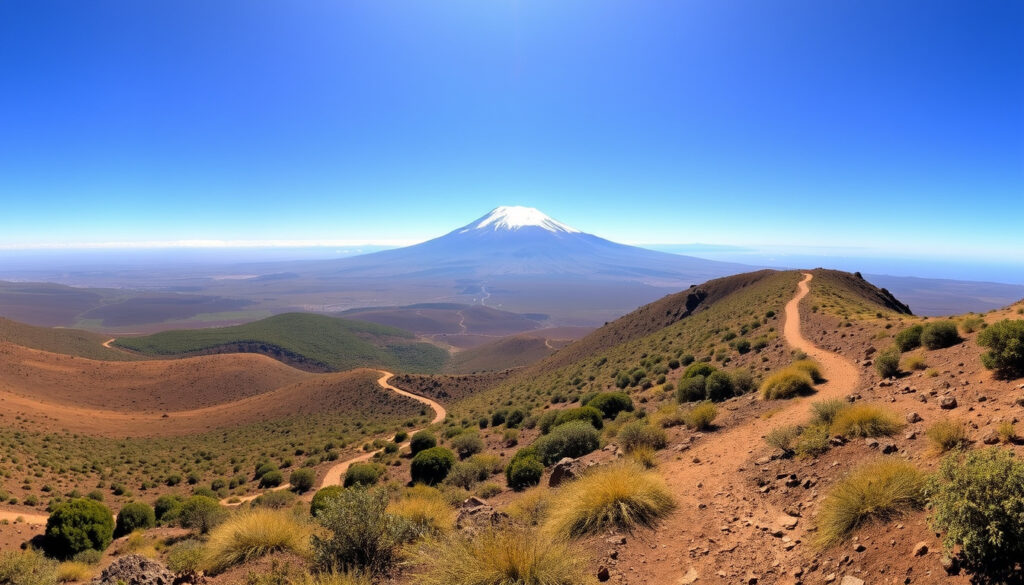
Mt Kilimanjaro – Elevation, Country, Hike Cost & Facts
Rising 5,895 meters above the East African plains, Mount Kilimanjaro is the highest peak in Africa and the world’s tallest free-standing mountain. Every year, roughly 25,000 trekkers attempt to reach its summit, drawn by a climb that requires no technical mountaineering yet demands careful planning. Understanding its elevation, location, route options, and costs is essential before setting foot on the mountain.
What is the elevation of Mount Kilimanjaro?
Kilimanjaro stands at 5,895 meters (19,341 feet) above sea level, according to official Tanzania surveys. This measurement places it firmly as the highest point on the African continent. The mountain rises from the surrounding plains at roughly 1,800 m, meaning the vertical ascent for most hikers is substantial. Official data from Tanzania National Parks confirms this measurement.
- Kilimanjaro is Africa’s highest mountain and the world’s tallest free-standing peak.
- The shortest hiking routes are about 53 km; the longest, the Northern Circuit, is roughly 98 km.
- A guided climb typically costs between US$1,500 and US$7,000, depending on route and operator.
- Kilimanjaro is an inactive stratovolcano – its last major eruption occurred about 360,000 years ago.
- Elevation gain from base to summit ranges roughly from 4,000 to 5,000 meters, depending on the starting gate.
| Fact | Value |
|---|---|
| Height (meters) | 5,895 m |
| Height (feet) | 19,341 ft |
| Country | Tanzania |
| Hike distance range | 53–98 km |
| Typical cost range | $2,000–$6,000 USD |
| Elevation gain (typical) | 4,000–5,000 m |
| Mountain type | Inactive stratovolcano |
Which country is Mount Kilimanjaro in?
Is Kilimanjaro in Tanzania or Kenya?
Mount Kilimanjaro lies entirely within Tanzania, near its northeastern border with Kenya. The massif is situated within Kilimanjaro National Park, about 225 km (140 miles) south of Nairobi. Despite its visibility from parts of Kenya, the summit and all slopes are under Tanzanian jurisdiction.
What is the closest town to Kilimanjaro?
The towns of Moshi and Arusha serve as the main gateways for treks. Moshi lies about 30 km southeast of the mountain, while Arusha is roughly 80 km to the southwest. Most organized climbs begin from one of these towns.
While the mountain is fully in Tanzania, its northern slopes are visible from the Amboseli region of Kenya. This often leads to the mistaken belief that the summit lies across the border.
How much does a Kilimanjaro hike cost?
What is included in the Kilimanjaro hike cost?
A complete guided climb to the summit usually includes park fees, guide and porter salaries, food, accommodation (huts or tents), and emergency oxygen. Prices vary by route, duration, and operator quality. Comparing offerings from operators like Ultimate Kilimanjaro can help clarify what different price tiers include.
Are there cheaper routes for Kilimanjaro?
The Marangu route, which uses hut accommodation, tends to be more affordable than camping routes. Budget group climbs start at about US$1,500–$2,500, while mid-range climbs run US$2,500–$4,000. Premium or private expeditions can cost US$4,000–$7,000 or more.
Official park fees are fixed, but operator and season cause cost fluctuations. Longer itineraries generally cost more but offer better acclimatization and higher summit success rates.
What are the distance, length, and elevation gain of the Kilimanjaro hike?
How long is the Kilimanjaro hike?
Most Kilimanjaro treks last between 5 and 9 days. The Marangu route is typically 5–6 days; the Northern Circuit takes 8–9 days. Longer itineraries provide more time for acclimatization.
What is the distance of the Kilimanjaro hike?
Trekking distances vary by route. The table below gives commonly cited distances, with data from TourRadar and other operators:
| Route | Typical duration | Approximate trekking distance |
|---|---|---|
| Marangu | 5–6 days | About 72 km (45 miles) round trip |
| Machame | 6–7 days | About 62 km (39 miles) |
| Rongai | 6–7 days | About 65–75 km (40–47 miles) |
| Lemosho | 7–8 days | About 70–80 km (43–50 miles) |
| Northern Circuit | 8–9 days | About 90–100 km (56–62 miles) |
| Umbwe | 5–6 days | About 50–55 km (31–34 miles) |
What is the elevation gain on the Kilimanjaro hike?
The vertical ascent from the starting gate to Uhuru Peak ranges roughly from 2,500 to 4,150 meters (8,100–13,600 ft) depending on the route. Summit day itself often involves a climb from a high camp (around 4,600–4,700 m) to the crater rim, then a descent of about 2,700 meters (8,900 ft) to a lower camp.
Altitude sickness is a major danger. Because the ascent is relatively accessible but reaches nearly 6,000 m, the body has limited time to adapt. Choosing a longer itinerary can reduce risk.
What is the geological and historical timeline of Mount Kilimanjaro?
- ~1 million years ago: Volcanic activity begins, eventually forming the Kilimanjaro massif.
- ~360,000 years ago: Last major eruption. The mountain becomes dormant.
- 1889: First recorded ascent – Hans Meyer and Ludwig Purtscheller reach the summit.
- 1921: Kilimanjaro is declared a forest reserve.
- 1973: Kilimanjaro National Park is established.
- 1987: The park is designated a UNESCO World Heritage Site.
- 2018: No eruption; false rumors circulating online are debunked.
What is certain and uncertain about Kilimanjaro?
| Established information | Information that remains unclear |
|---|---|
| The generally accepted height is 5,895 m (19,341 ft) as per official Tanzania surveys. | Slight variations in exact height exist (e.g., 5,892 m in some sources) due to measurement methods and glacial changes. |
| Kilimanjaro is located entirely within Tanzania. | Cost estimates vary significantly; official park fees are fixed but operator and season cause fluctuations. |
| It is an inactive (not extinct) stratovolcano – could erupt again in future. | Exact elevation gain per route is not always published – depends on start point. |
What makes Mount Kilimanjaro a world‑renowned peak?
Standing at 5,895 m, Kilimanjaro towers over the East African landscape. Unlike many high peaks, it requires no technical climbing, making it accessible to fit hikers. The mountain’s geology – comprising three volcanic cones (Kibo, Mawenzi, Shira) – and its ongoing glacial retreat provide rich context for visitors. Its location in Kilimanjaro National Park, a UNESCO World Heritage Site, adds to its global significance. The UNESCO listing recognizes its outstanding natural value.
What do official sources say about Mount Kilimanjaro?
“Mount Kilimanjaro is the tallest mountain in Africa, making it one of the seven summits.”
— Ultimate Kilimanjaro
“At 5,895 m (19,340 feet) above sea level, Kilimanjaro is the highest mountain in Africa and the highest free-standing mountain in the world.”
“The shortest hiking route on Mount Kilimanjaro is 53 km in length, and the longest route is 98 km.”
— TourRadar
“It is the highest free-standing peak globally, measuring 5,895 meters.”
What is the essential takeaway about Mount Kilimanjaro?
Mount Kilimanjaro is Africa’s highest mountain, a dormant stratovolcano in Tanzania, and a bucket‑list destination for trekkers. Its elevation, country location, route distances, and costs are well documented, though small variations exist in exact height and price. Planning with a longer itinerary and a reputable operator remains the best way to maximize safety and summit chances.
Frequently asked questions
Is Mount Kilimanjaro a volcano?
Yes, it is an inactive stratovolcano. It last erupted approximately 360,000 years ago.
Did Mount Kilimanjaro erupt in 2018?
No. Despite some online rumors, there was no eruption in 2018. The mountain is inactive.
Can you see Mount Kilimanjaro from Kenya?
Yes, the mountain is visible from parts of Kenya, but the summit and entire mountain lie within Tanzania.
How long does it take to climb Mount Kilimanjaro?
Most routes take 5–9 days depending on itinerary and acclimatization.
What are the three volcanic cones of Kilimanjaro?
Kibo (dormant), Mawenzi (extinct), and Shira (extinct) are the three cones that make up the massif.
Is technical climbing equipment required?
No. Standard routes are trekking routes; ropes and specialized climbing gear are normally unnecessary.
How many people climb Kilimanjaro each year?
Estimates place the number at roughly 25,000 attempted ascents annually.
More related posts
 Holy Island Tide Times 2026 – Safe Crossing & Live Status
 Professor Severus Snape – Biography, Age, Death and Actor
 Riley Reid – Complete Biography, Awards and Personal Life
 Edward Black Prince – Biography, Death, Family and Legacy
 Chloe Kelly – England Star, Euro Winner and Arsenal Forward
 Brian Harvey – Biography, Net Worth, and 2025 Updates
 Loft Bed – The Complete UK Guide for Adults 2025
 Chris Coghill – Age, Partner, Slow Horses Role and Biography
