Edward Black Prince – Biography, Death, Family and Legacy
Edward of Woodstock, better known as Edward the Black Prince, was the eldest son of King Edward III of England and Philippa of Hainault. Born on 15 June 1330 at Woodstock Palace in Oxfordshire, he became one of the most celebrated English commanders of the Hundred Years’ War. His military reputation was forged in his teenage years at the Battle of Crécy and cemented at the Battle of Poitiers, where he captured the French king. Despite being the heir apparent, he never ascended the throne, dying before his father in 1376 at the age of 45. He is buried at Canterbury Cathedral, where his elaborate tomb and armour remain on display.
The story of the Black Prince is a study in contrasts. He was praised by chroniclers like Jean Froissart as the flower of chivalry, yet his later campaigns, particularly the sack of Limoges, have drawn criticism from modern historians. His nickname, which emerged long after his death, is shrouded in uncertainty. Understanding his life means navigating both established facts and persistent questions about his character, his name, and the circumstances of his death.
Who Was Edward the Black Prince?
Edward of Woodstock was the first-born son of Edward III and Philippa of Hainault. He was created Prince of Wales in 1343, a title that marked him as the heir to the English throne. His life was defined by military leadership, a brief marriage to Joan of Kent, and an early death that changed the course of English succession.
Edward the Black Prince: Key Facts at a Glance
- Full Name: Edward of Woodstock
- Title: Prince of Wales, Duke of Cornwall, Prince of Aquitaine
- Born: 15 June 1330, Woodstock, Oxfordshire
- Died: 8 June 1376 (aged 45), Westminster, London
- Known For: Military leadership in the Hundred Years’ War (Crécy, Poitiers)
- Nickname Origin: Unknown – possibly from black armour, reputation, or heraldry
- Spouse: Joan, Countess of Kent
- Burial: Canterbury Cathedral
- Heir: Son Richard (later Richard II)
Several key insights help frame his importance in medieval history. He was the heir apparent who never became king, dying a year before his father. This led directly to the accession of his young son Richard II. His military career shows a pattern of early brilliance and later decline, mirroring the fortunes of the English in the Hundred Years’ War.
- Edward the Black Prince never became king; he died before his father Edward III, making him one of only a few heirs apparent to predecease the monarch. Historical records confirm he died in 1376, while Edward III died in 1377.
- The nickname ‘Black Prince’ was not used during his lifetime; the earliest recorded usage appears in the 16th century. Historians agree on this, though the exact origin remains uncertain.
- His military reputation is both celebrated for chivalry and criticized for brutality (e.g., the massacre at Limoges in 1370). Chronicles describe the sack of Limoges; modern historians debate the extent.
- Edward’s tomb in Canterbury Cathedral is a rare surviving example of a medieval prince’s tomb with a detailed brass effigy. The tomb includes his helm, shield, and surcoat; inscriptions identify him.
- His connection to Leeds (Kent) is via Leeds Castle, which he owned and later passed to his wife Joan. Historical records of royal grants and Leeds Castle official history confirm this.
| Fact | Detail |
|---|---|
| Born | 15 June 1330 at Woodstock Palace, Oxfordshire |
| Parents | King Edward III and Queen Philippa of Hainault |
| Created Prince of Wales | 12 May 1343 |
| Battle of Crécy | 26 August 1346 (aged 16) – led the vanguard |
| Battle of Poitiers | 19 September 1356 – captured King John II of France |
| Marriage | 10 October 1361 to Joan of Kent (his cousin) |
| Children | Edward (died young), Richard (later Richard II), and possibly others |
| Death | 8 June 1376 at Westminster, likely from dysentery |
| Tomb | Canterbury Cathedral, with a brass effigy and his heraldic achievements |
Why Was Edward Called the Black Prince?
The origin of the nickname “Black Prince” is one of the most persistent questions in medieval English history. Multiple sources, including the BBC, note that the name was not used during his lifetime. He was known primarily as Edward of Woodstock, a common naming practice based on his birthplace. The nickname “Black Prince” became common later, especially from Tudor times onward.
What Is the Origin of the Black Prince Nickname?
Several theories attempt to explain the name, but no single explanation is universally accepted. The most common theory, cited by the BBC and Historic UK, is that it referred to the colour of his armour. Some sources suggest he dipped his armour in tar to prevent rusting, giving it a black appearance. Others point to his use of a black shield at times.
A less widely supported theory links the name to his reputation for harshness or cruelty, particularly in his campaigns in France. The uncertainty is acknowledged by historians, with sources like the Dictionary of National Biography noting that the exact historical basis for the nickname remains debated.
No contemporary record from the 14th century uses the name “Black Prince.” The earliest written examples appear in the 16th century, around two hundred years after his death. This gap suggests the nickname was a later invention, possibly romantic in nature.
How Did Edward the Black Prince Die and Where Is He Buried?
Edward the Black Prince died on 8 June 1376 at Westminster Palace, near London. He was 45 years old. The cause of death is not recorded with certainty, but the most common theory is that he suffered from dysentery, a common illness among medieval soldiers returning from campaign. Some historians have suggested malaria or other long-standing illnesses, but the evidence remains inconclusive.
Where Is Edward the Black Prince Buried?
Edward was buried with great ceremonial grandeur at Canterbury Cathedral. His tomb there became a major memorial associated with his posthumous reputation. According to Britannica, his tomb includes a detailed brass effigy, along with his helm, shield, and surcoat, which are preserved and displayed on the tomb.
The tomb is a rare surviving example of a medieval prince’s funeral monument. It remains a significant tourist attraction and a place of historical interest, connecting visitors directly to the material culture of the 14th century.
The exact cause of Edward’s death is not definitively recorded in primary sources. Dysentery is the most widely accepted theory, but malaria and other illnesses have been suggested. The uncertainty arises because chroniclers of the time did not always record specific medical details.
Who Were Edward the Black Prince’s Wife and Children?
Edward married Joan of Kent, one of the most prominent noblewomen in England. The marriage took place in 1361 or 1362, depending on the source. Joan was his cousin, a fact that required a papal dispensation. The couple had at least two sons: Edward, who died young, and Richard, who would later become King Richard II. Some sources mention a daughter who died in infancy.
What Is Edward the Black Prince’s Family Tree?
Edward was the eldest son of King Edward III and Philippa of Hainault. His siblings included John of Gaunt, who became a powerful figure in his own right. Edward’s marriage to Joan of Kent linked him to the House of Kent. His son Richard II succeeded to the throne because Edward died before his father. This is considered one of the most important points about his biography: he never became king.
Who Succeeded Edward the Black Prince?
Since Edward died before his father, the throne passed directly from Edward III to his grandson, Richard II. Richard was only ten years old at his accession, which led to political instability and the eventual rise of the Lancastrian faction. The Black Prince’s son Edward, who died young, did not survive to become king.
Was Edward the Black Prince a Good Person?
Historical assessments of Edward’s character vary widely. Contemporary chroniclers like Jean Froissart praised him as the flower of chivalry, emphasising his courage and leadership at Poitiers. However, his later actions, particularly the sack of Limoges in 1370, have led to criticism. Modern historians like Michael Prestwich describe him as a man of his age, capable of both generosity and cruelty.
The question of whether he was a good person is subjective. He operated within the brutal norms of 14th-century warfare, where sackings and massacres were common. His reputation as a chivalric knight coexists with a record of harsh military actions. The BBC notes that his rule in Aquitaine later failed, and he returned to England in poor health.
What Armour and Artifacts Are Associated with Edward the Black Prince?
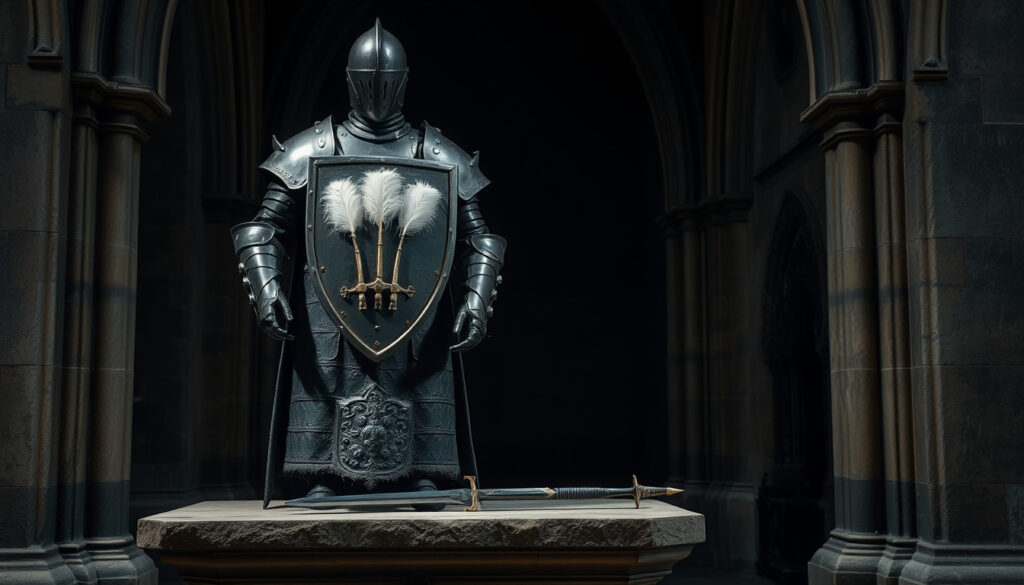
Several physical artifacts are directly linked to Edward the Black Prince. His helm, shield, and surcoat are preserved and displayed on his tomb in Canterbury Cathedral. These items are among the few surviving examples of 14th-century English princely armour.
What Is the Black Prince’s Connection to Leeds?
Edward’s connection to Leeds is through Leeds Castle in Kent. He owned the castle and later granted it to his wife, Joan of Kent. The castle remained in royal hands for centuries and is now a popular tourist attraction. This connection is one of the lesser-known aspects of his life, but it is well-documented in historical records of royal grants.
One theory about the Black Prince’s nickname suggests he dipped his armour in tar to stop it rusting, giving it a black appearance. Another says he used a black shield. Both explanations are widely repeated, but neither is confirmed by contemporary sources. The armour explanation remains the most common, though its historical basis is debated.
Timeline of Edward the Black Prince’s Life
- 15 June 1330 – Born Edward of Woodstock at Woodstock Palace, Oxfordshire.
- 12 May 1343 – Created Prince of Wales.
- 26 August 1346 – Fought at the Battle of Crécy (aged 16), leading the vanguard.
- 1355–1356 – Chevauchée through southern France culminating in the Battle of Poitiers (19 Sept 1356) and capture of King John II.
- 1361 – Appointed Prince of Aquitaine; married Joan of Kent (10 Oct).
- 1370 – Siege and sack of Limoges – a controversial event that tarnished his reputation.
- 1372 – Returned to England in failing health.
- 8 June 1376 – Died at Westminster, likely of dysentery or a long-standing illness.
- c. 1380 – Burial in Canterbury Cathedral; tomb adorned with his armour.
Certain vs. Uncertain Aspects of Edward the Black Prince
| Established Information | Information That Remains Unclear |
|---|---|
| His birth, death, and major life events are well-documented in contemporary chronicles and records. | The origin of the nickname ‘Black Prince’ is unknown; theories include his black armour, his reputation for harshness, or heraldic colors. No contemporary evidence uses the name. |
| His military achievements at Crécy and Poitiers are confirmed by multiple sources. | The exact cause of his death is not definitively recorded; dysentery is the most common theory, but malaria or other illnesses have been suggested. |
| He married Joan of Kent and had a son Richard who became king. | The extent of his brutality at Limoges is debated – some chroniclers exaggerated for effect. |
Analysis and Historical Context
Edward’s early military victories were remarkable, but some historians argue that he benefited from superior English longbow tactics and French disunity. His later campaigns in Aquitaine were less successful, and his rule there ended in failure. This raises questions about whether he was truly a military genius or simply a product of favourable circumstances.
The ‘Black Prince’ moniker likely emerged centuries after his death, possibly as a romantic label. Understanding this helps separate fact from legend. The name itself may have been a literary invention rather than a contemporary title.
His early death led to Richard II’s accession as a child, which contributed to political instability. The Black Prince’s reputation was used by later generations to legitimize or criticize the Plantagenet dynasty. His life connects several major themes of medieval English history: the Hundred Years’ War, the rise of royal heirs in military leadership, the politics of Joan of Kent, and the dynastic transition to Richard II.
Notable Quotes and Primary Sources
“He was the flower of all chivalry.”
Jean Froissart, Chronicles (c. 1400), referring to Edward’s conduct at Poitiers
“He was a great warrior, but also a man of his age – capable of both generosity and cruelty.”
Modern historian Michael Prestwich
“Edward of Woodstock, whom men call the Black Prince, was the eldest son of King Edward III.”
The Brut Chronicle (14th century)
Key sources for understanding Edward’s life include Jean Froissart’s Chronicles, Thomas Walsingham’s Historia Anglicana, Canterbury Cathedral records and tomb inscriptions, and official records of the Duchy of Cornwall.
What to Explore Next
To deepen your understanding of this period, compare Edward the Black Prince with other medieval commanders like Henry V. Explore the life of his son Richard II and the Peasants’ Revolt. Visit Canterbury Cathedral to see the Black Prince’s tomb and armour. Learn about the Hundred Years’ War and the role of the English longbow. You can also read the biography of another legendary military commander, Audie Murphy, or explore the life of another historical figure named Edward, the painter Edward Hopper.
Frequently Asked Questions About Edward the Black Prince
What is the Black Prince’s connection to Leeds?
Edward owned Leeds Castle in Kent; he granted it to his wife Joan of Kent. It remained in royal hands for centuries.
Did Edward the Black Prince ever become king?
No. He died before his father King Edward III, so his son Richard became king instead (Richard II).
How many children did Edward the Black Prince have?
He had at least two sons: Edward (who died young) and Richard (future Richard II). Some sources mention a daughter who died in infancy.
What happened to Edward the Black Prince’s armour?
His helm, shield, and surcoat are preserved and displayed on his tomb in Canterbury Cathedral.
Was the Black Prince a knight of the Garter?
Yes, he was one of the founding knights of the Order of the Garter by his father in 1348.
Why is he sometimes called Edward of Woodstock?
Because he was born at Woodstock Palace; it was a common medieval naming practice.
More related posts
 Ted Bundy – Complete Biography, Crimes, and Execution
 Mark Rutte – Biography, Career, Facts & Net Worth
 Benedict Cumberbatch – Biography, Height, Wife, Net Worth
 Andrew Ridgeley – Net Worth, Wife, Book and Life After Wham
 Elle Fanning – Age, Movies, Net Worth, and Biography (2025)
 Dirk Bogarde – Biography, Best Films and Personal Life
 Anthony Horowitz – Books, TV Shows, and Personal Life
 Shampoo for Greasy Hair – Top Picks and Oil Control Tips
