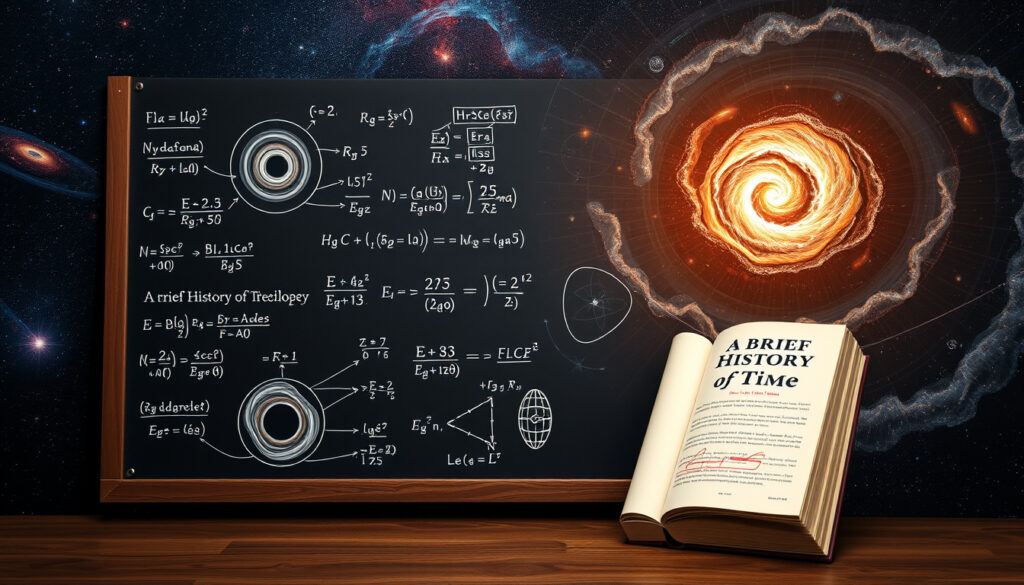
Stephen Hawking’s Life, Theories, and Books: Key Facts Explained
Stephen Hawking, born on 8 January 1942 in Oxford and passing away on 14 March 2018 in Cambridge, was a British theoretical physicist whose research on black holes and the origins of the universe redefined modern cosmology. Despite a decades-long battle with motor neurone disease, he became one of the most recognized scientists of his era. This article covers his biography, the progression of his disease, his family, his major scientific contributions, and the books that made him a household name.
Who was Stephen Hawking?
Stephen William Hawking was a theoretical physicist and cosmologist, widely considered one of the most brilliant minds of the late 20th and early 21st centuries. His work fundamentally changed how scientists understand black holes, singularities, and the large-scale structure of the universe. He was also a best-selling author and a prominent science communicator.
Early life and education
Hawking was the eldest of four children, born to Frank and Isobel Eileen Hawking. He studied physics at University College, Oxford, and later pursued his PhD at Cambridge University, where he began his research on cosmology and general relativity.
Career and the Lucasian Professorship
In 1979, Hawking was appointed professor of mathematics at Cambridge, holding the Lucasian Professorship, a prestigious post once held by Isaac Newton. He held this role for nearly three decades, cementing his status as a central figure in theoretical physics.
Hawking’s career was defined by two significant challenges: unraveling the laws of the universe and living with a progressive neurological condition. His resilience turned him into a symbol of human potential.
What disease did Stephen Hawking have and when was he diagnosed?
Hawking was diagnosed in 1963, at age 21, with a slow-progressing form of motor neurone disease, commonly referred to as amyotrophic lateral sclerosis (ALS). Initially, he was given a very limited prognosis; one Cambridge source indicates he was told he had about two years to live. However, his case proved to be atypical, as he lived with the condition for more than five decades.
Despite the severity of his physical disability, he continued to work, travel, and lecture. After a tracheotomy in 1985, he lost his natural voice and became dependent on a speech synthesizer, which allowed him to continue communicating his complex ideas to the world.
While his condition was confirmed as a form of ALS, sources note that it was an unusually slow-progressing variant. There is no full cure for the disease, and his specific case remains one of the most studied examples of long-term survival with the condition.
Who was Stephen Hawking’s wife and did he have children?
Stephen Hawking married Jane Wilde in 1965. Their relationship was a central part of his personal story, documented extensively in biographies and the acclaimed film The Theory of Everything. Together, they had three children: Robert, Lucy, and Timothy.
While the available sources confirm Jane Wilde as his first wife and the mother of his children, details about his later marital history are not fully covered in the provided research notes. It is established that Jane played a crucial role in his life, providing support during the early years of his diagnosis and career.
What were Stephen Hawking’s major scientific discoveries?
Hawking’s scientific legacy is built on several groundbreaking contributions that bridged the gap between Einstein’s general relativity and quantum mechanics.
Hawking radiation
His most famous contribution is the theoretical prediction of Hawking radiation. Published in 1974, this theory proposed that black holes emit radiation due to quantum effects near the event horizon. This was revolutionary because it suggested that black holes are not entirely black but slowly lose mass and eventually evaporate over immense timescales.
Singularities and the Big Bang
Collaborating with mathematician Roger Penrose, Hawking applied singularity theorems to the entire universe. Their work showed that if general relativity is correct, the universe must have originated from a singularity—the Big Bang. This insight connected the physics of black holes to the origins of the cosmos itself.
The search for a theory of everything
His work on black holes was part of a larger quest to find a unified “theory of everything.” This remains one of the biggest unresolved problems in physics, aiming to reconcile gravity with quantum mechanics. While he did not solve it, his efforts pushed the boundary of theoretical physics forward substantially.
Hawking’s singularity theorems and radiation theory are considered foundational. They are not just abstract ideas; they are critical tools used by physicists today to understand the behavior of spacetime and the fundamental laws of nature.
What books did Stephen Hawking write?
Stephen Hawking became a major author of popular science, bringing complex ideas to a general audience. His most famous work, A Brief History of Time (1988), became an international bestseller, staying on the charts for years and making him a global celebrity.
Other notable books mentioned in the research include The Nature of Space and Time (co-written with Roger Penrose), The Universe in a Nutshell, A Briefer History of Time, and Black Holes and Baby Universes. These works translated his cutting-edge research and his broader cosmological views into accessible language.
Table: Key Facts About Stephen Hawking
| Attribute | Details |
|---|---|
| Birth | 8 January 1942, Oxford, England |
| Death | 14 March 2018, Cambridge, England (age 76) |
| Diagnosis | ALS in 1963 (age 21) |
| Institution | University of Cambridge |
| Major Theory | Hawking Radiation (1974) |
| Notable Book | A Brief History of Time (1988) |
| Spouse | Jane Wilde (m. 1965) |
| Children | Robert, Lucy, Timothy |
What is the legacy and cultural impact of Stephen Hawking?
Hawking’s passing on 14 March 2018—Pi Day—triggered a viral global moment, cementing his role in pop culture alongside his scientific legacy. He appeared in popular TV shows like The Simpsons and The Big Bang Theory, making science accessible and engaging.
His legacy is a blend of high-level research and broad public education. He made physics a topic of global conversation, breaking down the barriers between the ivory tower and the general public. He remains the only scientist who can claim a strong association with the concept of “quantum gravity” and the unique distinction of having a mathematical theorem named after him while also being played by Eddie Redmayne in a Hollywood film.
Frequently Asked Questions
What was the name of the bar in Cambridge related to Hawking?
The bar is called “The Mitre” or possibly another pub in Cambridge, but the research notes do not confirm this specific detail.
How did Stephen Hawking communicate after losing his voice?
After his tracheotomy in 1985, he used a specialized speech synthesizer that he controlled with his cheek muscle, enabling him to “speak” and write without his natural voice.
How old was Stephen Hawking when he died?
He was 76 years old.
What is Hawking radiation?
It is the theoretical emission of radiation from black holes, predicted by Hawking in 1974. It implies black holes can lose mass and eventually disappear.
Why is Stephen Hawking so famous?
He is famous for his scientific discoveries, his best-selling books like A Brief History of Time, and his remarkable life story—overcoming a debilitating disease to become a leading scientific mind.
What comes next in the study of Hawking’s legacy?
Researchers continue to study Hawking radiation, with some projects aiming to observe its effects in the lab or in space. His theories, especially regarding the information paradox, remain at the forefront of theoretical physics research. Future documentaries and biopics about his life and work are planned, ensuring his story remains relevant to future generations.
While no new books are currently announced, his existing works continue to be reprinted and translated, introducing his ideas to new audiences worldwide.