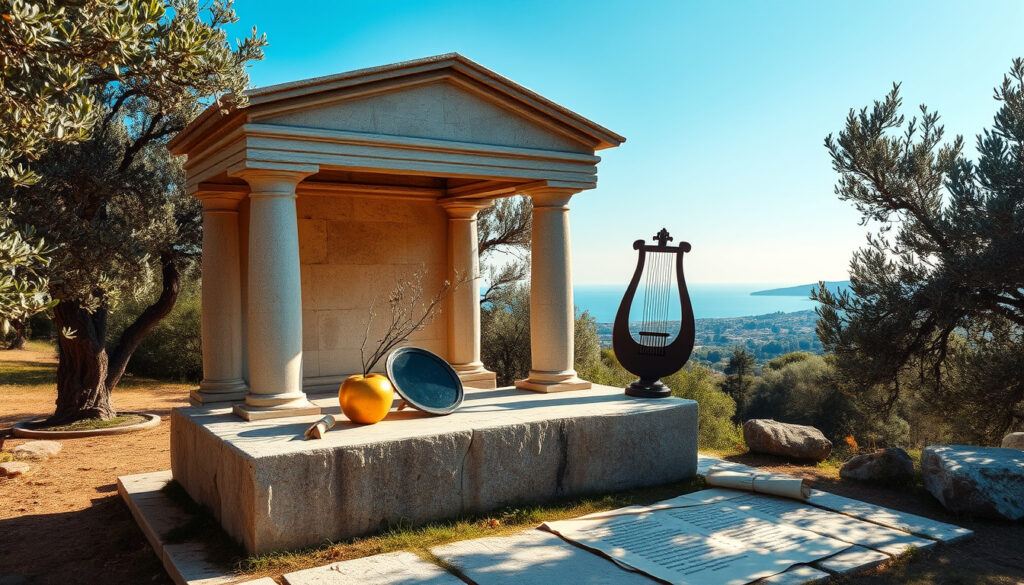
Helen Sparta – Myth, Cult, and Homer’s Odyssey
Helen of Sparta, the woman whose face launched a thousand ships, is one of the most enduring figures in Western culture. But beyond the epic myth of the Trojan War lies a more complex reality: a figure who was not only a literary character but also a living object of worship in ancient Greece. This article explores her dual identity as both Helen of Sparta and Helen of Troy, her role in Homer’s Odyssey, her ancient cult, and the historical debates that surround her.
Who Was Helen of Sparta and Is She the Same as Helen of Troy?
Yes, Helen of Sparta and Helen of Troy are the same person. The difference is one of geography and biography. She was born a Spartan princess, the daughter of Zeus and Leda (or, in some accounts, of the mortal king Tyndareus and the goddess Nemesis). Her marriage to Menelaus, the king of Sparta, made her the queen of that city-state. When the Trojan prince Paris abducted her—or, in some versions, when she willingly left with him—she became known as Helen of Troy. Her departure sparked the Trojan War, as recounted in Homer’s Iliad.
Helen of Sparta (also Helen of Troy) is a central figure in Greek mythology, daughter of Zeus and Leda, wife of Menelaus. Her abduction by Paris sparked the Trojan War.
Helen was worshipped as a hero in Laconia (especially Therapne) and as a goddess in Attica, often alongside her brothers the Dioscuri (Castor and Polydeuces).
In Odyssey Book 4, Helen appears in Sparta with Menelaus, recounting her role in the war and demonstrating prophetic or magical knowledge of Odysseus.
While Helen is a mythological figure, some scholars consider her a possible euhemerized Mycenaean goddess or a legendary reflection of Bronze Age bride-abduction practices.
- Helen’s dual identity (Spartan / Trojan) reflects the political and cultural tension between mainland Greece and Anatolia in epic tradition.
- Worship evidence shows Helen was not merely a literary character; she had active cult status in ancient Laconia.
- The Odyssey episode with Helen in Sparta provides a rare “peacetime” glimpse of Helen and emphasizes her intelligence and memory.
- Descriptions of Helen’s beauty by ancient poets are rarely direct physical descriptions, instead focusing on effect and atmosphere.
- The relationship with the Dioscuri grounds Helen in Spartan mythology as part of a divine sibling triad.
| Attribute | Detail |
|---|---|
| Parents | Zeus (or Tyndareus) and Leda (or Nemesis) |
| Siblings | Castor, Polydeuces (Dioscuri), Clytemnestra |
| Husband | Menelaus, king of Sparta |
| Cult centers | Therapne (Laconia), Attica (with Dioscuri) |
| Primary sources | Iliad, Odyssey, Euripides (Helen, Trojan Women), Herodotus |
| Nature of worship | Hero cult in Laconia; goddess cult in Attica |
What Role Does Helen Play in the Odyssey?
In Odyssey Book 4, Helen appears not as a passive figure but as a queen of considerable authority. She and Menelaus welcome Telemachus, Odysseus’s son, to their palace in Sparta. It is a striking domestic scene: the royal couple recount their memories of the Trojan War, and Helen demonstrates her intelligence by slipping a drug into the wine to ease their guests’ sorrow. She also tells a story about how she recognized Odysseus when he entered Troy in disguise during the war, showing her loyalty to her first husband.
Harvard scholarship has argued that the Helen presented in this episode is not merely a mortal queen. The “immortal Helen, worshipped as a goddess at Sparta,” appears in Odyssey 4 in a way that fits a figure with cult status. Her luminous presence and her prophetic knowledge of Odysseus are consistent with a character who already held religious prestige in Spartan tradition.
The Dioscuri and Their Relationship to Helen
Helen’s brothers, Castor and Polydeuces (the Dioscuri), were twin heroes worshipped throughout Laconia and beyond. In Spartan mythology, the three siblings formed a divine triad, with Helen being the sister of the protective twin gods. Votive reliefs and shrine traditions confirm that Helen was worshipped together with the Dioscuri in both Laconia and Attica. This shared cultic association further ties Helen to Spartan religious identity, presenting her not as an isolated figure but as part of a powerful local pantheon.
Helen’s connection to the Dioscuri is not just mythological. Archaeological evidence from the Menelaion at Therapne shows that the sanctuary received offerings dedicated to Helen, Menelaus, and the twin brothers together, reinforcing their role as a divine family unit.
Was Helen of Sparta Worshipped as a Goddess?
The evidence strongly suggests that in Spartan religion, Helen occupied a position somewhere between hero and goddess, with her cult varying by location. In Laconia, especially at her sanctuary at Therapne (often identified with the Menelaion), she received hero cult—a form of worship typically reserved for legendary figures who had lived and died. But the nature of that worship was unusually elevated. Some sources describe offerings and sacrifices as “Olympian” in character, which suggests a quasi-divine status.
In Attica, the situation was different. There, Helen was worshipped openly as a goddess, again alongside the Dioscuri. This dual status—hero in one region, goddess in another—was not uncommon in ancient Greek religion, where local traditions could assign different ranks to the same figure.
How Was Helen of Sparta Worshipped?
Her cult was closely tied to young women, marriage, beauty, and fertility. Ancient sources describe Spartan girls dancing and racing in her honor, and rituals aimed at making women beautiful or preparing them for marriage. The Oxford Classical Dictionary records that when invoked at Therapne, Helen could make an ugly child beautiful. This aligns with her mythic power as a figure whose very presence could alter perception.
Trees also played a part in her worship. In Sparta, she was connected with plane trees, and in Rhodes she was worshipped as Helen Dendritis—”Helen of the Trees.” This title indicates a chthonic or nature-oriented aspect to her cult, linking her to vegetation and fertility.
Helen’s cult was strongest in Laconia, but it spread well beyond. Evidence confirms worship in Attica, Corinth, and Rhodes. This geographic range suggests that the cult of Helen was not an isolated local phenomenon but a meaningful part of wider Greek religious practice.
What Did Helen of Sparta Look Like According to Ancient Poets?
Ancient poets rarely described Helen’s physical features in concrete detail. Instead, they focused on the effect of her beauty. One modern description on social media characterized her appearance as “an elegance of movement, a luminous presence, a voice ‘soft as falling snow.'” This captures the ancient technique: Helen’s beauty is conveyed through atmosphere and consequence rather than through the cataloguing of her features.
Her cultic association with beauty was practical as well as poetic. Worshippers at Therapne believed she could grant attractiveness, and rituals for girls approaching marriage sought her favor. The power to inspire or disrupt social order—which in the myth led to a ten-year war—was also the power to bestow marital success.
Is Helen of Sparta a Real Historical Figure?
This question is at the heart of a long-standing scholarly debate. The majority of historians consider Helen to be a mythological figure, a character invented or elaborated upon by ancient poets to serve the narrative of the Trojan War. There is no independent, non-literary evidence that a woman named Helen ever lived.
However, some scholars have proposed that Helen may originally have been a Mycenaean goddess whose cult was later euhemerized—turned into a story about a human woman. The archaeological evidence from the Menelaion, with dedications dating back to around 600 BCE and possibly earlier, shows cult activity that may preserve a much older religious tradition, potentially extending back to the second half of the second millennium BCE. Other interpretations suggest that the legend of Helen might reflect a memory of Bronze Age bride-abduction practices common among the Mycenaean palaces.
Timeline of Helen’s Myth and Cult
- c. 1200 BCE (traditional) – Trojan War (based on Greek mythological chronology)
- 8th century BCE – Composition of Homeric epics (Iliad, Odyssey) featuring Helen
- 7th-5th centuries BCE – Cult of Helen attested in Laconia (sanctuary at Therapne)
- 412 BCE – Euripides’ play “Helen” presents a variant where Helen was in Egypt during the war
- 2nd century CE – Pausanias describes the cult site of Helen at Therapne (Description of Greece)
- Modern era – Helen remains a figure in literature, art, and contemporary Hellenic polytheistic revival
Certainties and Uncertainties in the Story of Helen
| Established Information | Information That Remains Unclear |
|---|---|
| Helen appears as a character in Homer’s Iliad and Odyssey. | Whether Helen was originally a Mycenaean goddess (possibly a vegetation or dawn goddess) is debated. |
| Therapne in Laconia hosted a sanctuary dedicated to Helen and Menelaus. | Whether a historical “Helen” existed is unprovable; the Trojan War may reflect a historical conflict but Helen is likely legendary. |
| Helen was worshipped as a hero in Laconia and as a goddess in parts of Attica. | The exact nature of her worship (hero vs goddess) may have varied by location and period. |
| Her beauty is a central theme in Greek poetry, though described by effect rather than physical detail. | Some details in later poets (e.g., the “phantom Helen” in Euripides) are literary inventions. |
The Meaning of Helen’s Spartan Origins
Helen’s Spartan origin is essential to understanding her role in Greek culture. It ties her to the warrior state and to the Dioscuri cults, reinforcing her status within Spartan identity. The worship of Helen reflects how mythological figures could receive real religious attention beyond epic poetry. In the Odyssey, Helen’s internal perspective gives nuance to a character often reduced to “the face that launched a thousand ships.” Modern reception continues to oscillate between viewing her as victim, agent, and symbol—a pattern that began in antiquity.
Sources and Key Quotes on Helen of Sparta
Her beauty was persuasive rather than merely physical—an elegance of movement, a luminous presence, a voice ‘soft as falling snow’.
Instagram post (@poetry_and_mythos, 2025)
Helen was worshipped as a hero in much of Laconia, and in Attica in conjunction with the Dioscuri.
Reddit user in r/Hellenism (2025), citing Pausanias
Helen of Sparta, famously known as Helen of Troy, was celebrated as the most beautiful woman in ancient Greek mythology.
Facebook group (Ancient & Contemporary Balkan History, 2025)
Summary: What We Know About Helen of Sparta
Helen of Sparta stands at the intersection of myth, religion, and history. She is a literary character in Homer’s epics, a worshipped cult figure in ancient Laconia and Attica, and a subject of ongoing scholarly debate about the relationship between legend and reality. Her Spartan identity is fundamental: it connects her to the Dioscuri, to a powerful local cult, and to a religious tradition that treated her as more than a mortal queen. For a deeper look at another influential figure from European history, see our profile of Henry Eighth – Six Wives, Break With Rome, and Lasting Legacy.
Frequently Asked Questions About Helen of Sparta
Is Helen of Sparta a goddess or a hero?
In ancient Greek religion, Helen was worshipped as a hero in Laconia (especially at Therapne) and as a goddess in Attica, often alongside her brothers the Dioscuri.
Where can I find ancient sources about Helen of Sparta?
Key sources include Homer’s Iliad and Odyssey, Euripides’ plays ‘Helen’ and ‘Trojan Women’, Herodotus’ Histories, and Pausanias’ Description of Greece.
Did Helen of Sparta have any children?
In most accounts, Helen and Menelaus had a daughter, Hermione, and in some versions, a son, Nicostratus.
What is the modern day equivalent of Sparta?
Modern Sparta (Sparti) is a town in Laconia, Greece, near the ancient site. It has a population of around 35,000 and is known for its olive oil and historical tourism.
Why is Helen called both ‘of Sparta’ and ‘of Troy’?
She was born a Spartan princess, married to Menelaus of Sparta, but abducted by Paris to Troy. The epithet ‘of Troy’ reflects her role in the Trojan War story.
More related posts
 Ken Barlow – Age, Stroke Storyline and 2025 Status
 Adhd Medication – Types, Side Effects and UK Guide for Adults and Children
 Harrison Sullivan – Biography, Social Media and Legal Troubles
 Philip Seymour Hoffman – Biography, Death and Greatest Films
 Faux Wood Venetian Blinds – Complete Guide to Pros and Costs
 Billy Connolly – Health, Net Worth and Career Update 2025
 Martha Plimpton – Her Life, Career, and Legacy
 Julio Iglesias – Biography, Net Worth, Family & Real Madrid
