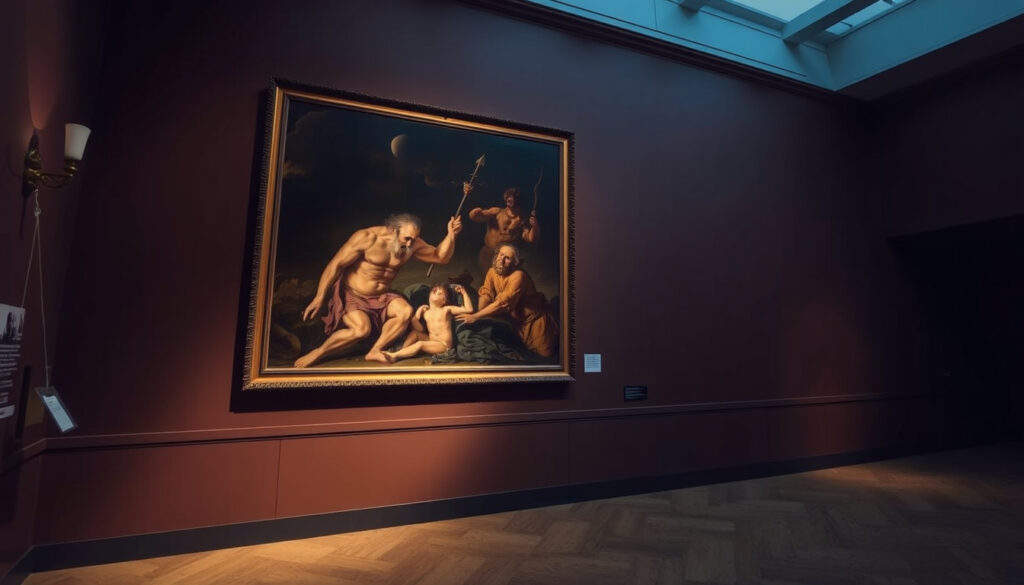
Saturn Devouring His Son – Goya’s Darkest Masterpiece Explained
Francisco Goya’s “Saturn Devouring His Son” is one of the most famous works from the Black Paintings: a dark, violent, and psychologically charged image usually read as a version of the myth of Cronus/Saturn devouring his children to prevent being overthrown. The painting now hangs in the Museo Nacional del Prado in Madrid, but it was originally painted on the plaster walls of Goya’s house, the Quinta del Sordo, before being transferred to canvas.
Goya produced the work between 1819 and 1823, the period of the Black Paintings. It belongs to a group of 14 murals he executed directly on the walls of his home. These images were not intended for public display, and Goya left no recorded title or explanation for any of them.
The scene shows a figure in a savage act of tearing and consuming a body. Because the artist never named it, the painting’s meaning has remained open to debate. It can be read as a myth, a political allegory, a meditation on time, or a psychological self-projection.
What Is Saturn Devouring His Son?
“Saturn Devouring His Son” is a late work by Francisco Goya (1746–1828), painted in the final period of his life. It is one of the Black Paintings, a series of 14 scenes created for the Quinta del Sordo, Goya’s house near Madrid. Unlike his earlier public commissions, these murals were private works that remained hidden for decades.
| Artist | Francisco Goya (1746–1828) |
|---|---|
| Series | Black Paintings (1819–1823) |
| Medium | Mixed technique on plaster wall, later transferred to canvas |
| Location | Museo del Prado, Madrid, Spain |
Five points matter most when approaching the painting:
- The painting is one of 14 Black Paintings Goya created directly on the walls of his home, Quinta del Sordo, between 1819 and 1823.
- It depicts the Roman myth of Saturn (Cronus) devouring one of his children to prevent a prophecy that he would be overthrown.
- The identity of the painting’s subject was not recorded by Goya; scholars pieced it together from contemporary descriptions and mythological clues.
- The work was transferred from plaster to canvas in the 1870s, a process that altered its appearance and raised conservation concerns.
- It is considered one of the most disturbing and enigmatic images in Western art, reflecting Goya’s pessimistic late period.
The Museo del Prado’s official entry records the basic catalog facts:
| Fact | Detail |
|---|---|
| Year painted | c. 1819–1823 |
| Dimensions | 146 cm × 83 cm (57 in × 33 in) |
| Original location | Dining room wall of Quinta del Sordo |
| Museum accession | Museo del Prado (since 1881) |
| Inventory number | P000765 |
| Technique | Oil mural on plaster, transferred to canvas |
| Mythological figure | Saturn (Greek Cronus) |
For a broader overview of the painting’s history and interpretations, Britannica’s entry on Saturn Devouring His Son is a useful starting point.
Why Did Goya Paint Saturn Devouring His Son?
Goya left no direct answer. The painting draws on the Greco-Roman story of Cronus (Roman Saturn), who swallowed his children after hearing a prophecy that one would overthrow him. But the image is not a literal classical illustration. The figure is shown in a savage act of tearing and consuming a body, which makes the scene more raw, immediate, and horrifying than traditional mythological depictions.
Which Myth Does the Painting Depict?
Cronus was a Titan in Greek mythology who learned that one of his children would take his throne. According to the story, he devoured his offspring to prevent that prophecy from being fulfilled. In Roman tradition, Cronus became Saturn.
Goya keeps the myth recognizable but removes any narrative distance. There is no classical setting, no symbolic accessory, and no written text. The action itself carries the meaning. For a fuller account of how the Greek and Roman versions relate, see Understanding the Myth of Cronus and Saturn.
What Are the Main Interpretations?
Common interpretations of the painting include:
- Time devouring all things. Saturn can symbolize Time, making the image an allegory of inevitable decay and destruction.
- Power and paranoia. The work is often read as a vision of tyranny, in which fear of losing authority produces self-consuming violence. A discussion of the painting’s political symbolism develops that reading.
- Old age and mortality. Some interpretations connect the painting to Goya’s own aging, illness, and confrontation with death.
- Spain’s violence and political trauma. Another reading sees it as an allegory of a nation consuming its own children through war and revolution.
Why Is the Painting Considered Disturbing?
The painting’s power comes from its directness. Dark pigments and heavy blacks surround the figure in darkness, while bold, gestural brushwork and strong chiaroscuro heighten the sense of terror and isolation. The stark, near-empty background strips away any classical setting and focuses attention on the act of violence.
A short Britannica video makes the same point: Goya turns the myth into something raw and immediate rather than distant and instructive.
Traditional depictions of the subject tend to keep the story at a distance. Goya removes that distance, leaving only the violent act itself.
Where Is Saturn Devouring His Son Located and How Did It Survive?
The painting’s path from a private house to a public museum explains much about its current state.
Where Did Goya Paint It?
Goya painted the image on the dining room wall of the Quinta del Sordo, a country house near Madrid. It was part of the larger mural cycle that became known as the Black Paintings. According to the Prado’s catalog entry, the Saturn scene faced another composition in the room, a work known as Leocadia.
The strange fate of these murals has drawn renewed attention in recent years. Artnet News has described Saturn Devouring His Son as “the disturbing masterpiece we were never meant to see.”
How Was the Mural Transferred to Canvas?
Goya left Spain for Bordeaux in 1823, and the house and its paintings were left behind. In 1873, the new owner of the Quinta del Sordo decided to sell the property, and the murals were deemed unmarketable. Between 1874 and 1878, under the supervision of the restorer Salvador Martínez Cubells, the Black Paintings were carefully transferred from plaster to canvas.
What Condition Is It In Today?
The transfer saved the images but changed them. The murals were removed from the walls, mounted on canvas, and later stabilized through conservation work. Treatments applied from the 1990s through the 2000s have helped maintain the painting, but the surface has aged, and the colors may no longer match what Goya originally painted.
The move from plaster to canvas altered the work. Conservation research indicates that the original colors may have shifted, so the image seen today reflects both Goya’s handling and the long history of restoration.
What Techniques and Style Define Saturn Devouring His Son?
What Materials Did Goya Use?
Goya executed the work directly on plaster using a mixed technique. Chemical analysis carried out by the Prado confirms that oil was used. After the transfer, the standard description became “oil mural on plaster, transferred to canvas.”
What Makes the Visual Style Distinctive?
Dark pigments and heavy blacks give the image its grim character, just as they give the Black Paintings their name. Goya’s brushwork is bold and gestural, with strong chiaroscuro that isolates the figure. The background is stark and nearly empty, and the rough, mural-like surface still hints at the painting’s origin on a domestic wall. A close reading of the composition by Painting Meanings stresses how that emptiness forces the eye toward the violent action.
How Does It Compare With the Rest of the Black Paintings?
The same technique and palette run through the whole series. The Black Paintings share a somber, disillusioned tone and an expressive handling that marks a clear departure from Goya’s earlier, more neoclassical style. Within that group, Saturn Devouring His Son stands out for the extremity of its subject.
The painting is on view in Room 67 at the Museo del Prado, where the dark pigments and the rough, mural-like surface can be examined directly.
How Did Saturn Devouring His Son Reach the Prado?
The journey from a private dining room to the museum took more than half a century.
- 1819–1823: Goya paints the Black Paintings directly onto the plaster walls of his country house, Quinta del Sordo, near Madrid.
- 1823: Goya leaves Spain for Bordeaux; the house and paintings are left behind.
- 1873: The new owner of Quinta del Sordo decides to sell the house; the murals are deemed unmarketable.
- 1874–1878: Under the supervision of Salvador Martínez Cubells, the Black Paintings are carefully transferred from plaster to canvas.
- 1881: The Spanish state acquires the paintings; they are brought to the Museo del Prado.
- 1883: The Black Paintings are first exhibited publicly at the Prado.
- 1990s–2000s: Conservation studies and restoration treatments are applied to stabilize the canvas.
- 2025: The painting remains on display at the Museo del Prado, and debate about its meaning and condition continues.
This sequence follows the historical account recorded by the Museo del Prado.
How Do We Know the Painting Depicts Saturn and His Son?
Goya never titled the Black Paintings and left no written description of their subjects. The name “Saturn Devouring His Son” was assigned by later scholars, who connected the image to the myth of Cronus/Saturn. That identification is now widely accepted, but it rests on indirect evidence.
The most careful examination of that evidence appears in a detailed answer on AskHistorians, which traces how the painting’s subject was identified from later descriptions after the Black Paintings left Goya’s house.
| Established information | Information that remains unclear |
|---|---|
| Goya painted the work on the wall of his dining room. | Goya never titled the painting; the name “Saturn Devouring His Son” was assigned later by scholars. |
| The work is part of the Black Paintings series. | The exact year of completion is unknown (c. 1819–1823). |
| It was transferred to canvas in the 1870s. | Whether Goya painted it for private expression or with a specific message is debated. |
| It is housed at the Museo del Prado. | Some historians question if the child is a son or daughter, though the male interpretation is standard. |
| The subject is the myth of Saturn devouring his son. | The original appearance has been altered due to transfer and aging; colors may have shifted. |
What Is the Significance of Saturn Devouring His Son in Art History?
Goya painted the Black Paintings after the Peninsular War and during a period of political repression in Spain. The series is often read as a reflection of his disillusionment and fear, and the myth of a ruler devouring his own children fits that atmosphere of menace.
In art history, the painting is regarded as a seminal work of Romanticism, one that anticipates Expressionism. Its raw brushwork, dark palette, and psychological intensity mark a clear break from the neoclassical style of Goya’s earlier career.
Interpretations vary widely. Some scholars connect the painting to Goya’s personal fears about aging and illness; others see a critique of tyranny or of the Spanish Inquisition; still others read it as a comment on the French occupation of Spain, or on human nature itself. A Smarthistory video examines the painting’s context and composition in detail.
What Do Key Sources Say About Saturn Devouring His Son?
Three passages come up often in discussions of the painting.
Saturn devouring one of his sons is one of the most expressive images from his Black Paintings. It occupied the wall across from Leocadia.
Museo del Prado official entry
Francisco Goya painted “Saturn Devouring His Son” on the walls of his country villa. The mysterious image has haunted art historians since.
Artnet News, 2025
How do we know that “Saturn Devouring One of His Sons” by Francisco Goya is in fact depicting Saturn and his child if the “Black Paintings” were not named…
AskHistorians, Reddit
Why Does Saturn Devouring His Son Still Matter?
Nearly two centuries after it was painted, Saturn Devouring His Son continues to resist a final explanation. It remains in the Museo del Prado, where visitors and scholars return to the same questions: what myth, what fear, and what period of Goya’s life produced this image. The painting’s power lies less in answering those questions than in leaving them open. For a full account of the series, see Goya’s Black Paintings: A Complete Guide.
What Are the Most Common Questions About Saturn Devouring His Son?
A few questions come up again and again in discussions of the painting.
What is the original name of Saturn Devouring His Son?
The painting has no known original name. Goya did not title his Black Paintings. The current name was given by art historians in the 19th century.
Is Saturn Devouring His Son a fresco?
No, it is an oil mural on plaster, later transferred to canvas. It is not a true fresco.
What does Saturn symbolize in the painting?
Saturn represents time and destruction. In myth, he ate his children to prevent being overthrown, symbolizing the cyclic nature of power and violence.
Has the painting ever been censored or removed?
Not officially, but its dark themes have led some to request it be covered or relocated for sensitive viewers. It remains on public display.
Are the Black Paintings for sale?
No, they are part of the permanent collection of the Museo del Prado and are not available for private purchase.
More related posts
 Jessie Murph – Age, Height, Net Worth, Songs and Tour
 Danny Mac – Hollyoaks Star, Strictly Contestant and Husband
 Where Is Virgin River Filmed – Full Locations Guide
 Kimbo Slice – Biography, Cause of Death, MMA Record and Legacy
 Liver King – Biography, Net Worth, and 2025 Controversy
 Timothy Busfield – What the Four Felony Counts Mean
 Henry Pollock – All You Need to Know About England and Lions Star
 Sean O’Malley – UFC Record, Next Fight & Net Worth
