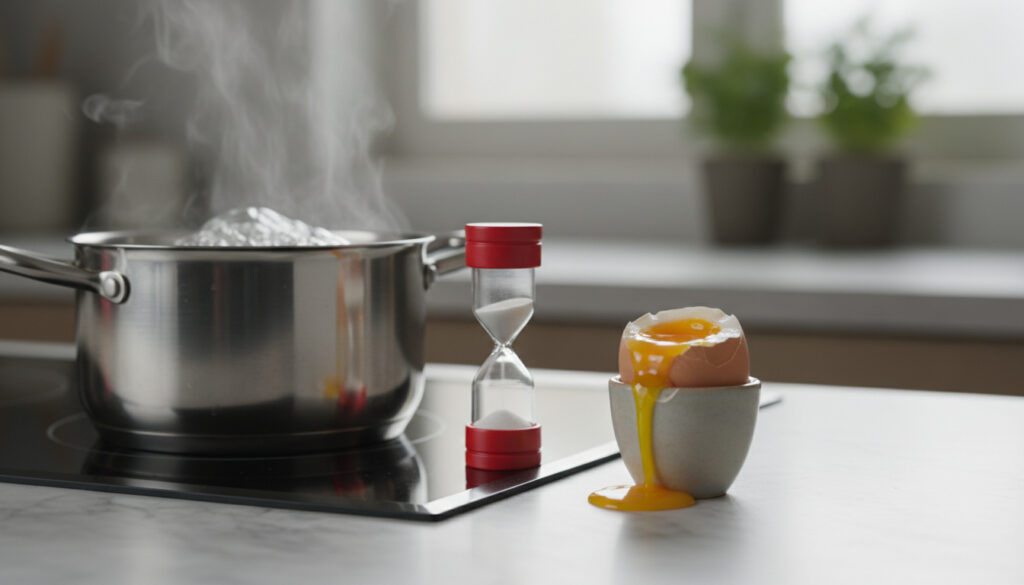
How Long for Soft Boiled Eggs – Exact Times for Runny Yolks
Soft boiled eggs with runny yolks require precise timing to achieve the ideal texture for dipping toast or topping grain bowls. Six minutes in actively boiling water produces whites that are fully set while maintaining a warm, liquid center that coats ingredients without additional sauce.
The cooking method matters as much as the duration. Starting with boiling water rather than cold eliminates variables in heating time, providing consistent results across batches. An immediate ice bath stops the cooking process, preventing residual heat from transforming the desired runny yolk into an overcooked firm center.
Variations exist within the soft boiled category. Seven minutes creates “jammy” eggs with creamy, partially set yolks, while nine minutes produces medium boiled eggs with firm but moist centers. Understanding these distinctions ensures appropriate texture for specific dishes.
How Long to Boil Soft Boiled Eggs?
- Boiling water starts provide more precise timing than cold water methods
- Six minutes yields runny yolks; seven minutes produces jammy centers
- Immediate ice bath immersion stops the cooking process completely
- Peeling eggs underwater helps shells release from delicate whites
- Shell-on eggs refrigerate safely for one week; peeled eggs last three days
- Gentle reheating in hot water prevents overcooking to hard-boiled texture
| Doneness Level | Time (Minutes) | Yolk Texture | Method |
|---|---|---|---|
| Soft Boiled (Runny) | 6 | Liquid center, fully set whites | Boiling water start |
| Jammy Eggs | 7 | Creamy, partially set | Boiling water start |
| Optimal Jammy | 6.5 | Balance of runny and firm | Boiling water start |
| Medium Boiled | 9 | Firm yolk, moist center | Boiling water start |
| Hard Boiled | 11 | Fully set, crumbly | Boiling water start |
| Cold Water Method | +5-10 min added | Variable consistency | Cold water start |
| Ice Bath Duration | 2-3 | N/A (cooling) | Ice water immersion |
| Shell-on Storage | Up to 7 days | N/A | Refrigeration |
| Peeled Storage | Up to 3 days | N/A | Refrigeration |
What Is a Soft Boiled Egg?
Defining the Texture
A soft boiled egg features fully set egg whites surrounding a warm, liquid yolk. The white should be firm enough to hold shape when peeled, while the center remains runny enough to coat toast or mix into rice dishes. This texture contrasts sharply with hard boiled preparations where both components become solid.
Soft Versus Medium Boiled
The distinction between doneness levels lies entirely in yolk consistency. At six minutes, the yolk remains entirely liquid. By nine minutes, the yolk achieves a firmer, cake-like texture while retaining moisture—characteristic of medium boiled eggs. Hard boiled eggs, cooked for eleven minutes, produce fully set, dry yolks suitable for slicing without mess.
Cooking times progress predictably: 6 minutes creates runny centers, 7 minutes yields jammy consistency, 9 minutes produces medium-firm yolks, and 11 minutes results in fully hard-boiled eggs. These benchmarks assume large eggs lowered into actively boiling water.
How to Make Perfect Soft Boiled Eggs
The Boiling Water Method
Bring a medium pot of salted water to a slow boil—not a rapid rolling boil. Gently lower eggs into the water using a slotted spoon, ensuring they rest in a single layer covered by approximately two inches of water. Starting with boiling water rather than cold eliminates the variable heating time, which can add five to ten minutes to the total process according to cooking demonstrations.
The Ice Bath Shock
Immediately transfer cooked eggs to an ice bath to arrest cooking. Create the bath by filling a bowl with three to four cups of ice and cold water or alternatively fill halfway with cold water and add a generous handful of ice. Allow eggs to sit for two to three minutes until cool enough to handle safely without burning.
Maintain approximately two inches of water above the eggs during cooking. This ensures even heat distribution and prevents temperature fluctuations when adding eggs to the pot.
Peeling Technique
Peel eggs while submerged in water to help shells release from the delicate whites. Use the edge of the bowl to gently crack the shell in the center, then work carefully around the egg. Handling gently throughout prevents the soft whites from breaking apart during the process.
Soft Boiled Eggs Using Alternative Methods
Stovetop Variations
While boiling water starts provide the most reliable results, some practitioners begin with cold water. This method adds five to ten minutes of cooking time as the water heats, making precise timing difficult. The texture also varies depending on stove output and pot material.
Other Appliances
Specific timing for microwave or air fryer soft boiled eggs remains undocumented in available research. These methods vary significantly by appliance wattage and air circulation patterns, creating potential safety risks including uneven cooking or explosion hazards.
Available research does not include verified timing instructions for microwave or air fryer soft boiled eggs. Stovetop boiling remains the only tested method for achieving consistent results with predictable yolk textures.
Minute-by-Minute Cooking Process
- 00:00 — Bring salted water to slow boil; gently lower room-temperature eggs into single layer using slotted spoon
- 04:00 — Whites begin to set firmly around exterior while yolk remains completely liquid
- 06:00 — Minimum time for runny yolk completion; whites fully set but tender according to timing tests
- 06:30 — Optimal jammy texture achieved with partially set creamy yolk per kitchen testing
- 07:00 — Classic jammy egg consistency reached with custard-like center as documented
- 09:00 — Medium boiled stage; yolk firm but moist without crumbling
- 11:00 — Hard boiled completion; yolk fully set and crumbly throughout
- 11:00+ — Immediate transfer to ice bath required to prevent residual heat from overcooking
Established Facts Versus Uncertain Variables
| Established Information | Information Not Verified |
|---|---|
| Six minutes produces runny yolks in boiling water | Specific timing adjustments for egg size variations (small to extra-large) |
| Boiling water start provides precision; cold start adds 5-10 minutes | Altitude compensation requirements for high-elevation cooking |
| Ice bath requires 2-3 minutes cooling time | Effects of egg freshness on cooking time and peelability |
| Shell-on storage lasts 7 days; peeled lasts 3 days | Microwave soft boiling parameters and safety protocols |
| Peeling underwater assists shell removal | Air fryer timing specifications for consistent results |
| Seven minutes creates jammy texture; eleven minutes hard boiled | Batch cooking modifications for large quantities |
The Role of Soft Boiled Eggs in Cooking
Soft boiled eggs serve as versatile components in breakfast dishes, salads, and grain bowls. Their runny yolks create natural sauces that coat ingredients without additional dressing, while the firm whites provide structural protein. The texture contrast between solid whites and liquid centers offers sensory variety in otherwise simple preparations.
Nutritionally, eggs offer protein and fat content that pairs well with fiber-rich foods. Those considering balanced morning meals might examine Are Apples Good for You – Nutrition, Benefits and Daily Limits when planning complementary breakfast components. Unlike hard boiled eggs, soft boiled preparations require immediate consumption after peeling to maintain the optimal texture differential between white and yolk.
Expert Guidance on Egg Preparation
Jammy eggs require seven minutes of cooking time, while soft boiled eggs with runnier centers cook for six minutes. Medium boiled eggs need nine minutes, and hard boiled eggs require eleven minutes.
— Cook at Home Mom
Six and a half minutes produces the optimal jammy texture, noting that five and a half minutes creates a yolk that is too runny, while seven minutes begins to approach hard boiled.
— Abra’s Kitchen
Immediately transfer cooked eggs to an ice bath to stop the cooking process.
— The Organic Kitchen
Key Takeaways for Soft Boiled Success
Achieving perfect soft boiled eggs requires six minutes in boiling water for runny yolks or seven minutes for jammy centers. The boiling water method provides necessary precision, while an immediate ice bath preserves the desired texture. For techniques requiring similar precision in measurement and timing, see How to Inject Mounjaro – Step-by-Step Guide and Tips. Store shell-on eggs for up to one week, and always peel underwater for clean removal.
Frequently Asked Questions
How long for jammy eggs?
Seven minutes produces jammy eggs with creamy, partially set yolks. Six and a half minutes offers optimal texture between runny and firm according to tested recipes.
Can I soft boil quail eggs?
Specific timing for quail eggs has not been established in available research. Their smaller size would require reduced cooking time, though exact minutes remain unverified.
Are soft boiled eggs safe to eat?
Soft boiled eggs are generally safe when prepared properly using clean eggs. However, specific USDA temperature guidelines for soft preparations were not detailed in available sources.
Why do my soft boiled eggs not peel easily?
Difficult peeling often occurs with very fresh eggs, though specific freshness effects remain unstudied in available research. Peeling while submerged in water helps shells release.
How do you reheat soft boiled eggs?
Dunk peeled eggs in hot water for a few minutes to warm without overcooking the yolk to hard-boiled consistency. Avoid microwave reheating.
What is the difference between soft and hard boiled eggs?
Soft boiled eggs cook for six minutes with runny yolks; hard boiled eggs require eleven minutes for fully set, crumbly centers. The five-minute difference transforms texture completely.
Should I start with cold or boiling water?
Boiling water starts provide precise timing. Cold water starts add five to ten minutes of variable heating time, making consistency difficult to achieve.
More related posts
 Donny Osmonds – Biography, Net Worth, Family, and Current Shows 2025
 Anya Chalotra – Age, Height, Parents, and Career Facts
 Loft Bed – The Complete UK Guide for Adults 2025
 Ann Dowd – Biography, Husband, Height, and Filmography
 Ken Bruce – Age, Wife, Net Worth, Health and Radio Schedule 2025
 Charlie Hunnam – Biography, Movies, Net Worth and Height
 2 Child Benefit Cap – Scrapped How Much Extra You Get
 Francis Ford Coppola – En Mästares Väg Till Legend
