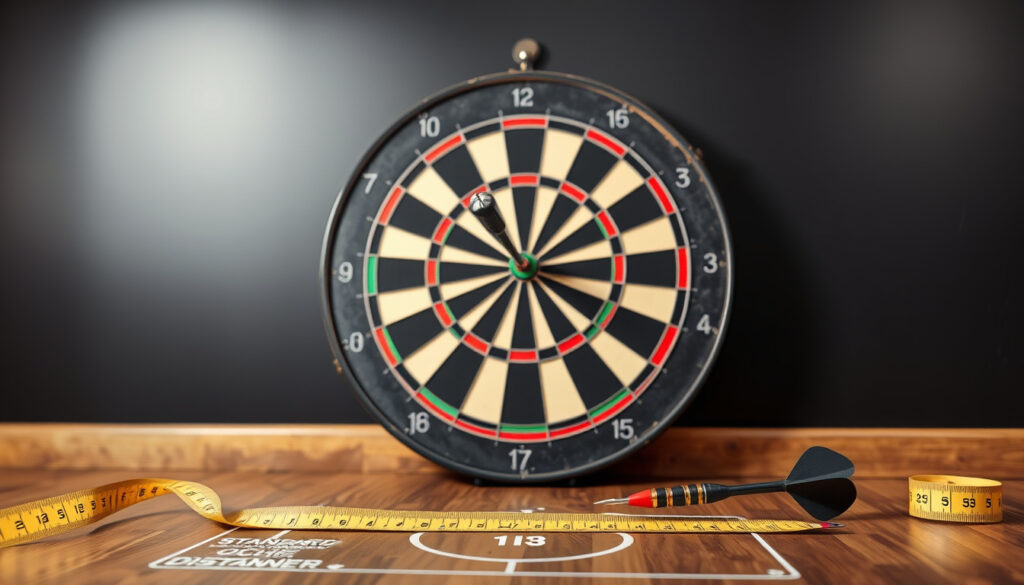
Dartboard Distance – Official Guide to Steel Tip & Soft Tip Setup
Getting the dartboard distance right is the first step to setting up a practice space that feels fair and professional. Whether you’re throwing steel-tip or soft-tip darts, a small measurement error can change the way your darts land in the board. The good news is that the rules are surprisingly consistent, and the most important numbers are easy to remember.
Why Does the Dartboard Distance Matter So Much?
Players often focus on technique, but the throwing distance directly affects dart trajectory, grouping, and scoring consistency. A distance that is even one inch off changes the angle of entry into the board, which can significantly impact performance for competitive players. Official bodies like the World Darts Federation (WDF) and the British Darts Organisation (BDO) enforce these measurements to ensure fairness across all venues.
The distance used in professional play is not stricter or more demanding than what you should use at home. The official measurements create a standard so that a player competing in a local league is throwing from the exact same position as a professional on television.
Quick Overview: Essential Dartboard Setup Numbers
| Measurement | Steel-Tip | Soft-Tip |
|---|---|---|
| Bullseye Height | 5 ft 8 in / 1.73 m | 5 ft 8 in / 1.73 m |
| Throw Line (Oche) Distance | 7 ft 9¼ in / 2.37 m | 8 ft / 2.44 m |
| Diagonal Measure (Bullseye to Oche) | 9 ft 7¼ in / 2.93 m | 9 ft 9¾ in / 2.99 m |
| Board Diameter | 18 in / 45.72 cm | 18 in / 45.72 cm |
| Oche Width (Minimum) | 24 in / 61 cm | 24 in / 61 cm |
Key Insights: What Most Guides Agree On
- The throwing distance is measured diagonally from the face of the dartboard to the oche, not from the wall.
- The bullseye height is identical for both steel-tip and soft-tip boards.
- The steel-tip oche distance is 7 ft 9¼ in (2.37 m) from the board face.
- The soft-tip oche distance is 8 ft (2.44 m) from the board face.
- Measuring from the board face rather than the wall is crucial for a correct setup.
- The diagonal measurement is a more accurate way to verify the setup than a simple horizontal one.
Official Dartboard Measurement Table
| Specification | Standard Measurement |
|---|---|
| Official distance for steel tip darts | 7 ft 9¼ in (2.37 m) |
| Official distance for soft tip darts | 8 ft (2.44 m) |
| Bullseye height from floor | 5 ft 8 in (1.73 m) |
| Board dimensions (standard) | 18 inches (45.72 cm) diameter |
| Throwing line (oche) width | Minimum 24 inches (61 cm) |
| Measurement reference | Diagonal from board face to oche |
How to Measure the Distance Accurately: Board Face vs. Wall
One of the most common mistakes in dartboard setup is measuring from the wall. Since a dartboard is typically mounted on a bracket that holds it a few inches off the wall, the distance from the wall to the oche will always be shorter than the official distance. Always measure from the face of the dartboard (the front playing surface) to the back edge of the oche.
Steel-tip setups often have thinner mounting brackets, while soft-tip boards sometimes come with thicker backs. If you are using a very thick board, this difference becomes even more important. The wall distance will vary based on the board mount depth, so using the board face as your reference point eliminates all guesswork.
Is It Horizontal or Diagonal?
While many people think of the “throw line distance” as a straight horizontal line from the board to the floor, the official method is slightly different. The distance is measured diagonally from the center of the bullseye to the back of the oche on the floor. This ensures that the angle of the throw is consistent, regardless of the board’s depth.
To check your setup, use a tape measure from the exact center of the bullseye to the back edge of the oche. This diagonal line is the official distance you need to match.
Use a laser distance measurer for precise board-to-oche measurement. This eliminates the risk of a sagging tape measure and ensures the diagonal line is accurate.
Does the Thickness of the Board Matter?
Yes, the thickness of the board matters. Because the official distance is calculated from the face of the board, a board that is thicker will naturally sit closer to the wall. If you measure from the wall, you will create the wrong distance. For home setups, it’s advisable to measure from the board face to account for the bracket and board thickness.
Common Setup Questions: Steel Tip vs. Soft Tip Differences
The primary difference between steel-tip and soft-tip setups is the throwing distance. The height remains identical, but the distance changes by format. Using the wrong distance can affect play accuracy and might even damage your board over time if you’re consistently hitting at the wrong angle.
Can I Use 7 ft 9.25 in for Both?
No. The steel-tip distance is 7 ft 9¼ in (2.37 m), while the soft-tip distance is 8 ft (2.44 m). Many home players try to use a single distance for both, but this is incorrect. If you play both formats, you need to have clear markings on your floor for each distance, or you need to move your oche line.
What About Professional Distances?
The official distances are the same for all levels of play in sanctioned events. Professional players do not throw from a longer distance. The regulations set by organizations like the World Darts Federation and the Darts Regulation Authority are consistent across amateur and professional competitions.
The diagonal measurement from the bullseye to the oche is often cited as the most accurate way to check a setup. For steel-tip, this diagonal is 9 ft 7¼ in (2.93 m). For soft-tip, it’s 9 ft 9¾ in (2.99 m).
A Timeline of Dartboard Measurement Standardization
The current standardized distances weren’t always the norm. Over the years, the rules have evolved to create a fair playing field for everyone.
- 1920s-1930s: The standard “hockey” or “football” style distances varied widely, and no single governing body established a universal rule.
- 1970s: The British Darts Organisation (BDO) began formalizing official rules, standardizing the bullseye height at 5 ft 8 in and the oche distance to 7 ft 9¼ in for steel-tip darts.
- 1980s: The rise of electronic dartboards for soft-tip darts led to the establishment of a separate distance of 8 ft for electronic boards.
- 1990s-Present: International bodies like the World Darts Federation (WDF) adopted these measurements globally, ensuring consistency in tournaments worldwide.
What Is Certain and What Remains Unclear in Setup Guides?
Most reputable sources agree on the core measurements, but there are slight inconsistencies in some published guides. Here’s a breakdown of what is established and what is still occasionally misreported.
| Established Information | Information That Remains Unclear |
|---|---|
| Bullseye height is 5 ft 8 in (1.73 m) for both formats. | Some sources incorrectly state the soft-tip distance as 2.43 m instead of the more common 2.44 m (8 ft). |
| Steel-tip oche is 7 ft 9¼ in (2.37 m) from the board face. | One guide contains a unit error, converting 7 ft 9¼ in incorrectly to 2.73 m instead of about 2.37 m. |
| Soft-tip oche is 8 ft (2.44 m) from the board face. | The exact width of the oche line can vary slightly between different rulebooks, though a minimum of 24 inches is common. |
| The measurement is taken diagonally from the board face to the oche. | Some older guides recommend measuring horizontally from the wall, which leads to incorrect setups. |
The Meaning and Origin of the “Oche” Distance
The term “oche” (pronounced “ocky”) refers to the throwing line in darts. Its origins are debated, but it is widely believed to come from the Anglo-Saxon word for a mark or a notch. In the modern game, it is the line behind which a player must stand when throwing. The distance ensures that all players have the same physical challenge when aiming for the board. The official rules state that a player’s foot must not cross the back edge of the oche, and this distance is a key part of the game’s integrity. For a deeper look at these official standards, you can consult the World Darts Federation Official Rules. Also, the Darts Regulation Authority provides rules for professional play that align with these measurements.
For further reading on the specific measurements, you can check out the guide on Dartboard Height and Distance from CSW Darts, and for a step-by-step approach, see the How to Set Up a Dartboard guide from Throwdown Darts. Some additional guides from DartShopper and A-Z Darts offer helpful visuals and tips. The GLD Products official measurements page is also a useful reference. More technical setup advice can be found at Darts501 Setup and Darts-Oche.
Summarizing the Standard Dartboard Distance
Getting the dartboard distance correct is a simple but vital part of the game. The bullseye must be 5 ft 8 in (1.73 m) high, the steel-tip oche must be 7 ft 9¼ in (2.37 m) away, and the soft-tip oche must be 8 ft (2.44 m) away, all measured diagonally from the board face. Following these numbers ensures a consistent and fair playing experience. For more setup details, you can always revisit the official dartboard measurement guide.
Frequently Asked Questions
How high should the bullseye be from the floor?
The bullseye should be exactly 5 ft 8 in (1.73 m) from the floor to the center of the bullseye. This applies to both steel-tip and soft-tip dartboards.
Do I measure from the wall or the board face?
Always measure from the face of the dartboard (the front playing surface) to the oche. The wall distance will vary based on the board mount depth, so the board face is the correct reference point.
Can I use a tape measure for setup?
Yes, a standard tape measure works, but ensure it’s taut and measure diagonally from the center of the board face to the back edge of the oche. A laser measurer is even more accurate.
What is the correct distance for soft-tip darts?
The official distance for soft-tip darts is 8 ft (2.44 m) from the face of the board to the oche. This is longer than the steel-tip distance of 7 ft 9¼ in.
Does the width of the oche line matter?
Yes, the oche line must be at least 24 inches (61 cm) wide. Players must stand behind the back edge of this line when throwing.
Is the professional distance different from the amateur distance?
No. The official distance is the same for all levels of play in sanctioned events. Whether you are playing in a local league or a world championship, the distance remains 7 ft 9¼ in for steel-tip and 8 ft for soft-tip.
More related posts
 Magic The Gathering Final Fantasy – Release Date, Cards, Products Guide
 Valor da Libra em Real – Today’s GBP/BRL Rate and History
 Gael Monfils – Age, Height, Wife, Net Worth and Ranking 2025
 Varun Dhawan – Biography, Movies, Age, Wife And Upcoming Films 2025
 Quinta Brunson – Age, Height, Career and the Betty Boop Rumors
 Karen Mulder – 2026 Comeback, Vogue Cover and Allegations
 Morgan Rogers – Age, Position, Chelsea Transfer & Career Facts
 Lena Headey – Biography, Career, Net Worth, and Her Most Famous Roles
