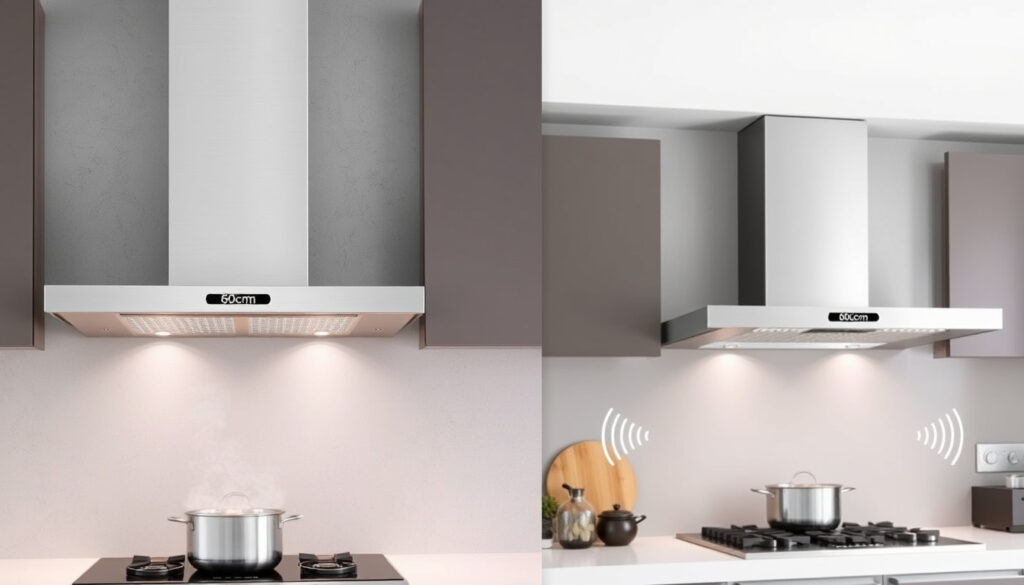
Cooking Hood – 60cm vs 90cm Extraction & Noise Guide
Cooker Hood Buying Guide 2025: 60cm vs 90cm, Extraction & Noise Levels
Choosing a new cooker hood means weighing up size, ventilation type, noise levels and brand reputation. This guide lays out the key differences between 60 cm and 90 cm hoods, explains when ducted or recirculating models work best, and gives practical noise and maintenance advice based on current UK retail data and manufacturer specifications.
What size cooker hood do I need? 60 cm vs 90 cm
60 cm standard, 90 cm for larger hobs or islands
Extraction (ducted) or Recirculation (ductless)
Typically 35–65 dB; quieter models near 35–45 dB
AEG, NEFF, Beko, Bosch, Samsung, own‑label
- Most UK kitchens use 60 cm hoods over a 60 cm hob; 90 cm hoods are recommended for 90 cm hobs or island setups.
- Extraction (ducted) outperforms recirculation for removing steam and odours, but requires external venting.
- Noise is a top purchase factor; models below 45 dB are considered ‘quiet’ for open‑plan kitchens.
- AEG and NEFF dominate the premium segment; brands like Beko and own‑label offer budget options.
- Filter maintenance: grease filters every 2–4 weeks, carbon filters every 3–6 months (recirculation).
| Specification | Value |
|---|---|
| Standard Width | 60 cm (most common), also 90 cm, 70 cm |
| Extraction Rate | Measured in m³/h; minimum 400 m³/h recommended |
| Noise Range | 35–65 dB (quiet to loud) |
| Filter Types | Grease (metal or mesh), Carbon (charcoal) |
| Installation Type | Wall‑mounted, island, integrated, downdraft, telescopic |
| Average Price (UK) | £80–£500 (standard); premium models £400+ |
A hood should be at least as wide as the hob, and ideally a little wider for better capture. For a 60 cm hob, a 60 cm hood is the minimum common choice; a 90 cm hood can be used if wall space allows and better coverage is desired. For a 90 cm hob or range cooker, a 90 cm hood is the minimum baseline. Hill & May’s buying guide and Presshive’s ducted vs ductless guide both confirm these sizing standards.
Should I choose extraction or recirculation?
Extraction (ducted) hoods vent air outside after grease filtration, so they remove steam, grease and odours more effectively. Recirculation (ductless) hoods clean the air with grease and activated carbon filters and send it back into the kitchen. Several guides note that recirculation can be less effective at odour removal than extraction.
When ducted makes sense
If you have an external wall or ducting route, a ducted hood is the stronger choice for performance. It is also usually quieter because the air does not have to fight through additional filter resistance.
When recirculation is the only option
In flats, or kitchens where installing ducting is impractical, recirculation is the workable alternative. Expect more noise and the need to replace carbon filters every 3–6 months.
For open‑plan kitchens, experts recommend aiming for 60 dB or below at working speed, and ideally 55 dB or under at medium speed. Cata’s quiet hood guide explains how ducted systems help meet these targets.
How noisy is a cooker hood? Understanding dB levels
Cooker hood sound power commonly falls between 40 and 70 dB(A) depending on the speed setting. Many buyers’ guides describe 60–70 dB as typical for domestic hoods, with anything above that becoming distracting. A practical target is below 60 dB on the setting you use most often, and ideally around 55–60 dB for normal use.
What to look for on the spec sheet
Check the noise figure at normal or working speed, not just maximum speed. Also check the extraction rate in m³/h – higher extraction can improve performance but may increase noise. Neutratest’s buying guide notes that “silent” models are often cited as around 30 dB(A) on minimum and 55 dB(A) on maximum.
Quiet models for open‑plan kitchens
If you have an open‑plan kitchen, a model that stays below 45 dB can make a significant difference. Brands such as AEG and NEFF offer quieter motors, but always check the dB rating for the speed you will use most.
Always compare noise levels at the same speed. Some manufacturers quote the lowest possible figure, which may be on a barely‑used low setting. Quiet Mark’s extractor advice warns that buyers frequently over‑value maximum‑speed noise figures.
Which cooker hood brand is best? AEG, NEFF and more
AEG and NEFF dominate the premium segment in the UK. Both manufacturers offer models with high extraction rates and lower noise levels, but exact specifications vary by model. The research data does not include model‑specific AEG or NEFF manuals, so individual noise and extraction figures should be verified against the product page. Budget brands such as Beko and own‑label hoods from retailers like Currys or Howdens can provide good value, though they may be noisier than premium alternatives.
Comparing AEG and NEFF
Both brands supply 60 cm and 90 cm models, with wall‑mounted, island and integrated options. NEFF’s design language tends to emphasise sleek, minimalist flues, while AEG offers a broader range of price points. For definitive comparisons, check the official pages: AEG UK Cooker Hoods and NEFF UK Extractor Hoods.
Budget alternatives
Beko, Samsung and own‑label brands from AO.com can be effective if you are on a tighter budget. The key is to prioritise extraction rate over brand name, and to accept that noisier operation may be a trade‑off.
How has the cooker hood evolved over time? Key milestones
- 1950s – First extractor hoods introduced for commercial kitchens.
- 1970s – Domestic cooker hoods become common; grease filters standardised.
- 1990s – Recirculating hoods with carbon filters gain popularity.
- 2010s – Quiet motors and energy‑efficient LED lighting introduced.
- 2020s – Smart hoods with app control, voice assistant integration, air quality sensors.
What is certain and uncertain about cooker hoods?
Established information
- A 60 cm hood fits a 60 cm hob; a 90 cm hood fits a 90 cm hob.
- Ducted extraction removes steam more effectively than recirculation.
- Carbon filters must be replaced regularly for recirculation to work.
Information that remains unclear
- Whether premium brands (AEG, NEFF) are always quieter than budget brands – this depends on the specific model and its dB rating rather than the brand alone.
Why the right cooker hood matters
A cooker hood is essential for maintaining air quality, reducing moisture, and preventing grease build‑up in the kitchen. The choice between 60 cm and 90 cm, extraction vs recirculation, and noise level can significantly impact comfort and performance. Many buyers focus only on price or appearance, but long‑term satisfaction depends on matching the hood to the hob width, kitchen layout (ducting possible?) and lifestyle (cooking frequency, open‑plan living). Brands like AEG and NEFF offer higher build quality and quieter operation, but at a premium. Budget options from retailers like Currys or AO.com can be effective if selected carefully.
Expert sources and quotations
“Extraction (ducted) is more effective and usually quieter than recirculation.”
“Recirculation is generally noisier because the air must pass through filters and added airflow resistance creates extra turbulence.”
“For open‑plan kitchens, sources recommend aiming for 60 dB or below at working speed, and ideally 55 dB or under at medium speed.”
Additional authoritative sources include Applianceshop’s buying guide, Southern Review’s cooktop hood guide, and the official product pages of AEG, NEFF, Currys, and Howdens.
Next steps after buying a cooker hood
Once you have chosen your hood, measure the hob width and check the ducting route before ordering. Arrange professional installation if you are not confident with electrical work. Clean grease filters every 2–4 weeks and replace carbon filters every 3–6 months if you use recirculation mode. For a broader perspective on kitchen ventilation, see our Cooker Hood Buying Guide.
Frequently asked questions
How often should I replace the carbon filter?
Every 3–6 months if using recirculation mode. Some manufacturers recommend every 3 months.
Can I wash cooker hood filters in the dishwasher?
Yes, aluminium grease filters can be washed in a dishwasher. Carbon filters cannot be washed and must be replaced.
Do all cooker hoods have lights?
Most modern hoods have integrated LED lights. Check the product spec for brightness and colour temperature.
What is the difference between a chimney hood and an integrated hood?
Chimney hoods are wall‑mounted with a visible flue; integrated hoods are built into a cabinet and hidden.
Are Beko cooker hoods any good?
Beko offers solid budget options with decent extraction rates, though they may be noisier than premium brands.
More related posts
 Yu Menglong – Biography, Death and Career Facts
 Olly Alexander – Biography, Songs, Eurovision & Personal Life
 Les Ferdinand – Biography, Career, and Personal Life Guide
 Eni Aluko – Biography, Age, Husband and Net Worth 2025
 Bonehead Oasis – Cancer Diagnosis, Biography & Net Worth
 HL Club Playa Blanca – Honest Review, Waterpark & All Inclusive Guide
 Henry Pollock – All You Need to Know About England and Lions Star
 Emily Head – Biography, Career, and Family Facts
