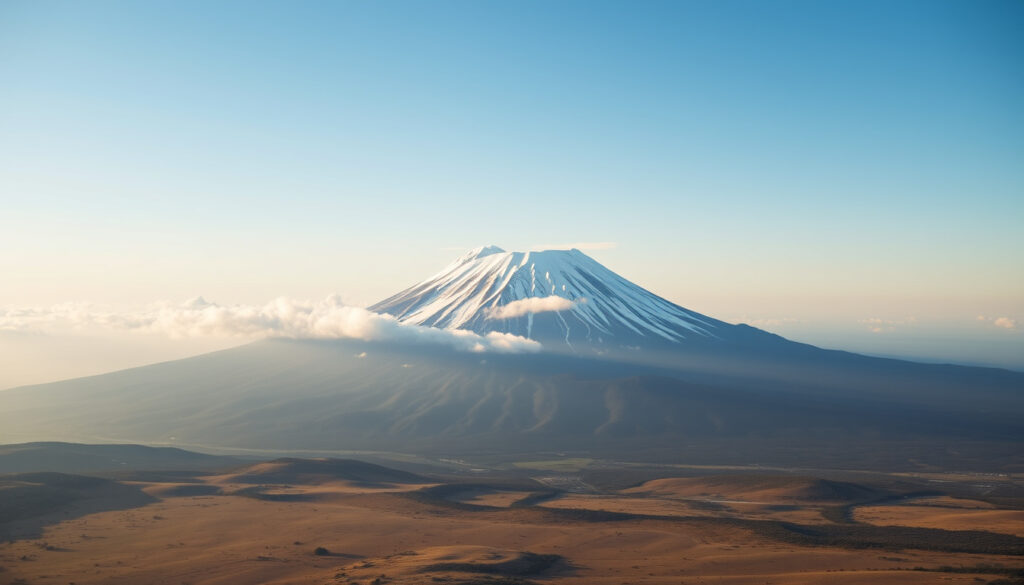
Mountain Kilimanjaro
Where is Mount Kilimanjaro Located?
| 📏 Height 19,341 ft (5,895 m) |
📍 Location Tanzania, East Africa |
| 🌋 Type Freestanding Stratovolcano |
🕰️ Last Eruption ~200,000 years ago (dormant) |
Key insights at a glance
- Kilimanjaro is a dormant stratovolcano made up of three distinct volcanic centres: Kibo, Mawenzi and Shira.
- Because it is a free-standing mountain, the elevation gain from the base to the summit is roughly 4,900 m — more relevant to climbers than the total height above sea level.
- Despite lying near the equator, the summit supports a permanent ice cap, though the glaciers are retreating.
- Altitude, not climate or steep terrain, is the primary cause of illness on the mountain, a common misconception among first-time hikers.
- In a 2005 study, 61.3 % of climbers reached the summit while 77 % experienced acute mountain sickness (AMS).
- The summit, Uhuru Peak, sits on the rim of the dormant Kibo cone.
Quick facts about Mount Kilimanjaro
| Stat | Detail |
|---|---|
| 5,895 m (19,341 ft) | Official height |
| 6–8 days | Typical climb duration |
| Tanzania | Country of location |
| Highest free-standing mountain | Geological claim |
| Dormant | Volcanic status |
| ~10,000 per year | Approximate number of failed summit attempts |
How Tall is Mount Kilimanjaro and Why is it Unique?
The most widely accepted height of Kilimanjaro is 5,895 m (19,341 ft) above sea level, measured at Uhuru Peak. Some sources cite slightly different values — between 5,890 and 5,892 m — but the consensus among authoritative references, including Wikipedia, National Geographic and Britannica, places the official figure at 5,895 m.
Is Mount Kilimanjaro a free-standing mountain?
Yes. Kilimanjaro is the highest free-standing mountain in the world, meaning it rises independently from the surrounding plains rather than as part of a mountain range. This gives it a vertical relief of about 4,900 m from base to summit, a factor that creates a sustained elevation gain uncommon among non-expedition peaks. UNESCO describes the area as protecting the largest free-standing volcanic mass on Earth.
Is Mount Kilimanjaro a volcano?
Kilimanjaro is a stratovolcano built from layers of lava, ash and rock. It comprises three distinct cones: Kibo (the highest and the only one considered dormant), Mawenzi and Shira. Kibo last experienced a major eruption roughly 200,000 years ago and is now classified as dormant rather than extinct. Mawenzi and Shira are extinct.
Is Mount Kilimanjaro an Active Volcano?
Kilimanjaro is not an active volcano. Scientific monitoring indicates that Kibo, the highest cone, has been dormant since its last major eruption approximately 200,000 years ago. No historical eruptions have been recorded, and the volcano is not expected to erupt in the foreseeable future.
Did Mount Kilimanjaro erupt in 2018?
No. Rumours of an eruption in 2018 circulated online after minor seismic activity was detected near the mountain, but geological authorities confirmed that the tremors were not volcanic in origin. The seismic events were attributed to tectonic adjustments along the East African Rift, not magma movement.
Scientists continue to monitor Kilimanjaro for seismic activity as a precaution, but the volcano is considered dormant. The primary hazards on the mountain today are related to altitude and weather, not volcanic eruption.
How Long Does It Take to Climb Kilimanjaro?
Most guided climbs on Kilimanjaro take between six and eight days, depending on the route chosen and the acclimatisation schedule. Shorter itineraries exist, but they carry a higher risk of altitude sickness and lower summit success rates.
What is the hiking distance for Mount Kilimanjaro?
The total hiking distance varies by route, ranging from roughly 40 km (25 mi) on the shortest path to about 70 km (43 mi) on longer, more scenic trails such as the Northern Circuit. All routes require multiple days of ascending and descending to allow for gradual acclimatisation.
What is the best time to climb Kilimanjaro?
The most favourable climbing windows fall during the dry seasons: January to March and July to October. These months typically offer clearer skies, less precipitation and more stable trail conditions. The long rains (March to May) and short rains (November) are generally avoided due to muddy paths, low visibility and higher risk of weather-related delays.
Data from a 2005 study showed that 77 % of climbers experienced acute mountain sickness, and overall summit success was 61.3 %. Longer itineraries with built-in acclimatisation days significantly improve the odds of reaching the top safely.
Is Mount Kilimanjaro Dangerous? Assessing the Risks
Kilimanjaro is not technically difficult — it does not require ropes, ice axes or advanced climbing skills — but the altitude creates genuine risks. Acute mountain sickness, high-altitude pulmonary oedema (HAPE) and high-altitude cerebral oedema (HACE) are the primary medical threats. These conditions can affect anyone, regardless of fitness level.
How many people die on Kilimanjaro?
A precise overall death rate for Kilimanjaro has not been reliably established in the available sources. What is clear is that altitude illness is the leading cause of fatalities, as noted by simplified references and general climbing guides. Search results do not provide a single authoritative figure for annual deaths, but they consistently highlight that serious illness — rather than falls or accidents — accounts for most fatalities.
Is Mount Kilimanjaro evil?
No. This idea stems from superstition rather than fact. Some online stories link the mountain to urban legends such as the “Green Boots” tale, but these narratives are not supported by credible evidence. Kilimanjaro is a natural geological formation, and its dangers are well understood and manageable with proper preparation and guided support.
The available information indicates that altitude sickness is the main risk, not volcanic activity or supernatural causes. The absence of a confirmed death rate in the research material underscores the need for better data, but it does not diminish the reality that thousands of people summit safely each year with proper acclimatisation and medical awareness.
When did Kilimanjaro last erupt and what is its volcanic history?
Kilimanjaro’s volcanic activity spans more than two million years. The timeline below summarises the key geological and human events based on current scientific understanding.
- ~2.5 million years ago — Initial volcanic activity began, forming the Shira volcano.
- ~1.9 million years ago — Mawenzi volcano became active.
- ~1 million years ago — Kibo volcano, which now hosts the highest summit, began to form.
- ~200,000 years ago — Kibo’s last major eruption occurred; the volcano subsequently became dormant.
- 1889 — First successful summit by Hans Meyer and Ludwig Purtscheller.
- 1932 — First non-African aerial photograph of the summit; glaciers were still extensive.
- 1960s — Scientific studies began documenting glacial recession in detail.
- 2018 — Seismic activity raised public concern, but no eruption occurred; the tremors were non-volcanic.
What is known and what remains uncertain about Kilimanjaro?
| Established information | Information that remains unclear |
|---|---|
| Kilimanjaro is located in Tanzania, East Africa, near the Kenya border. | Although the volcano is dormant, volcanic hazards are not entirely zero; monitoring continues. |
| It is the highest mountain in Africa at 5,895 m (19,341 ft). | The precise annual death rate for climbers is not established in available sources; altitude illness is the known primary cause. |
| It is a dormant stratovolcano; the last major eruption occurred more than 200,000 years ago. | Glacier volume and precise ice loss figures are not provided in the current research data, though recession is documented. |
| Kilimanjaro is a free-standing mountain not part of a range. | Some height measurements vary slightly (5,890–5,892 m), though the consensus is 5,895 m. |
What makes Kilimanjaro geologically and historically significant?
Geologically, Kilimanjaro is not a single volcano but a composite of three cones — Shira, Mawenzi and Kibo — whose formation is linked to the East African Rift system. This makes it a key site for studying continental rifting and volcanic evolution.
Historically, the first recorded ascent in 1889 marked a turning point in exploration, transforming Kilimanjaro from an obscure geographical feature into a global adventure destination. Today, the mountain supports a significant tourism industry that brings economic benefits to Tanzania while also posing environmental challenges.
The most pressing human impact is not an eruption but the rapid recession of Kilimanjaro’s ice cap. NASA and UNESCO have documented the shrinking glaciers, which serve as a visible indicator of climate change. The loss of ice affects local water supplies and underscores the mountain’s role as a sentinel for global warming. For those seeking a shorter yet rewarding summit experience, our guide on Arthur’s Seat – Hiking Routes, Height And Visitor Guide offers an accessible urban alternative to high-altitude trekking.
What do authoritative sources say about Kilimanjaro?
“Kilimanjaro is the highest mountain in Africa and the highest free-standing mountain above sea level in the world, at 5,895 m (19,341 ft) above sea level.”
— Wikipedia’s Mount Kilimanjaro page
“The mountain is located in Tanzania, near the Kenyan Border in East Africa.”
— Global Adventure Challenges guide
These two sources — an encyclopedic reference and an operator’s guide — align on the core geographic and physical facts. Additional authoritative references include NASA’s Earth Observatory, which documents the summit’s permanent snow cap, and UNESCO, which protects the area as a World Heritage site.
What should prospective climbers take away from this guide?
Kilimanjaro is a non-technical climb that requires no specialised mountaineering skills, but altitude sickness poses a real and common risk. Success depends on choosing a route with adequate acclimatisation, travelling during the dry seasons, and preparing for the physical demands of high-altitude trekking. The mountain is not dangerous in the way that active volcanoes or technical alpine peaks are, but it demands respect for the environment and one’s own limits. For those considering the challenge, understanding the facts — from location and height to risk and history — is the first step toward a safe and rewarding experience. For contrast with another notable hiking destination, see our guide on Arthur’s Seat – Hiking Routes, Height And Visitor Guide.
Frequently asked questions about Kilimanjaro
Is Kilimanjaro a dangerous mountain to climb?
It is not technically dangerous in the sense of rock falls or crevasses, but altitude illness is a significant risk. Most deaths are attributed to AMS, HAPE or HACE rather than falls.
Do I need oxygen to climb Kilimanjaro?
No. The mountain is climbed without supplemental oxygen on standard routes. Proper acclimatisation is the key to managing reduced oxygen levels.
How many people attempt to climb Kilimanjaro each year?
Tens of thousands of people attempt the climb annually. Success rates vary by route and itinerary, with longer schedules yielding better outcomes.
What is the youngest age to climb Kilimanjaro?
The minimum age set by most park authorities and operators is 10 years old, though younger children have summited with special arrangements. Age limits are enforced for safety.
Is Kilimanjaro visible from Nairobi?
On clear days, the snow-capped summit can sometimes be seen from Nairobi, which lies roughly 160 km (100 mi) north of the mountain.
What wildlife lives on Kilimanjaro?
The lower slopes host elephants, buffalo, leopards and monkeys. Higher elevations support fewer species due to cold and low oxygen.
How much does it cost to climb Kilimanjaro?
Prices vary widely, but a reputable guided climb typically costs between $2,000 and $5,000, depending on route, duration and operator.
Can I climb Kilimanjaro without a guide?
No. Tanzanian law requires all climbers to be accompanied by a licensed guide. Independent climbing is not permitted.
What is the success rate for summiting Kilimanjaro?
Overall success rates hover around 45–65 %, with longer itineraries producing significantly higher chances. Shorter trips increase the risk of failure due to altitude.
What should I pack for a Kilimanjaro climb?
Essentials include layered clothing, a sleeping bag rated for sub-zero temperatures, waterproof gear, trekking poles, and high-SPF sunscreen. A full packing list is best obtained from your operator.
More related posts
 Generation Millennials – Birth Years, Traits, and Comparisons
 Michael Eavis – Net Worth, Health, Family and Legacy in 2025
 Patti Smith – Biography, Songs, Books and Robert Mapplethorpe
 Debbie Harry – Age, Net Worth, Biography and 2025 Update
 Joe Alwyn – Biography, Movies, and Relationship with Taylor Swift
 Karen Mulder – 2026 Comeback, Vogue Cover and Allegations
 Robert Palmer – Cause of Death, Family and Life Story
 Tom Lehrer – Satirist Behind ‘The Elements’ Dies at 97
