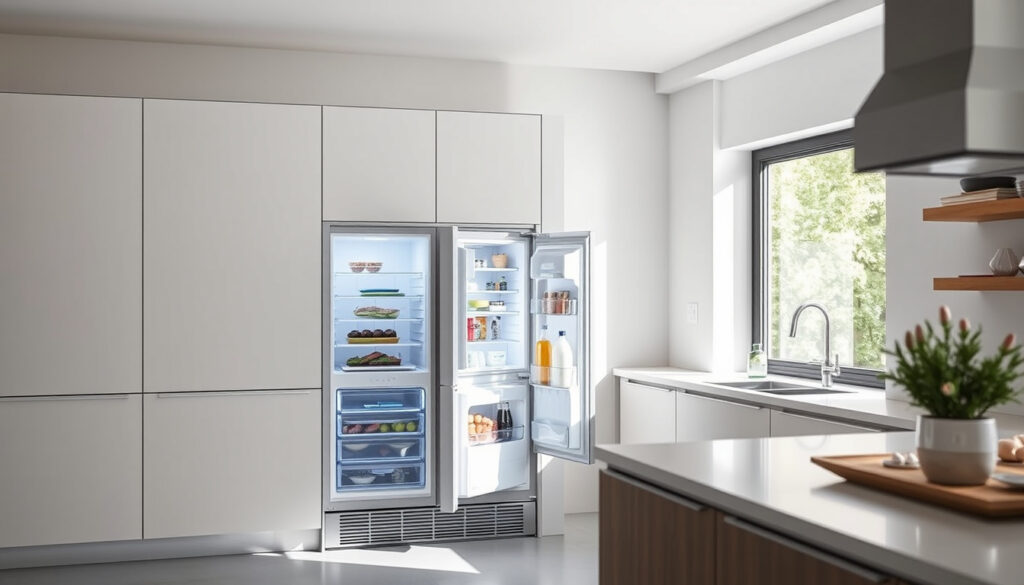
Integrated Fridge Freezer – Complete UK Buying Guide 2025
An integrated fridge freezer is one of the most important appliances in a modern fitted kitchen, designed to sit flush behind a cabinet door for a seamless look. But choosing the right model involves more than matching the width of your cupboard. From split ratios to frost-free technology, the options can be overwhelming. This guide pulls together the key facts you need to make an informed purchase in 2025.
The UK market for integrated fridge freezers has matured significantly over the past two decades. Most models now fit a standard 60cm-wide cabinet, but heights and depths vary, and the way the internal space is divided between fridge and freezer has a big impact on day-to-day usability. Understanding these basics is the first step toward finding a unit that suits your household.
Whether you are replacing an old appliance or fitting out a new kitchen, the information below draws on independent testing, retailer data, and manufacturer specifications to give you a clear picture of what is available in 2025. For a broader look at home appliance buying, you might also find our Shipping Container – Complete UK Buying Guide 2025 useful for understanding product dimensions and logistics.
What Sizes Do Integrated Fridge Freezers Come In? (50/50, 60/40, 70/30 Explained)
50/50, 60/40, 70/30, 80/20
Frost Free, No Frost, Fan Cooling, Fast Freeze
£350 – £1,500+
Bosch, AEG, Samsung, Beko, Hotpoint
The ratio of fridge volume to freezer volume is the most critical specification after overall dimensions. These ratios are expressed as percentages: a 50/50 model gives equal space to each section, while a 70/30 model devotes 70% to the fridge and 30% to the freezer. The choice depends on whether you buy fresh food daily or rely heavily on frozen ingredients.
- The 50/50 split is most popular for UK kitchens, but 60/40 offers more fridge space which many families prefer.
- Frost free technology eliminates manual defrosting but can be slightly noisier and may use more energy than no frost models.
- Integrated fridge freezers require proper ventilation (usually at the back and top) to function correctly; wrong installation can void warranty.
- Energy ratings: most new models are A to D under the 2021 label; look for A or B for best efficiency.
- Price does not always correlate with quality – mid-range brands like Beko and Hotpoint often offer great value with frost free and good energy ratings.
| Split Ratio | Fridge Capacity (approx.) | Freezer Capacity (approx.) | Typical Height | Typical Width |
|---|---|---|---|---|
| 50/50 | 150L | 150L | 177-180cm | 55-60cm |
| 60/40 | 180L | 120L | 177-180cm | 55-60cm |
| 70/30 | 210L | 90L | 177-180cm | 55-60cm |
| 80/20 | 240L | 60L | 177-180cm | 55-60cm |
According to Which?, you should match the ratio to your fresh versus frozen shopping habits, because integrated models generally offer less total capacity than freestanding ones. Smeg’s buying guide adds that a 60/40 split gives a slightly larger fridge section while keeping a practical freezer size, making it a good middle ground for many households.
What Does Frost Free Mean on an Integrated Fridge Freezer?
Frost free – also called No Frost – is a feature that automatically reduces ice build-up inside the freezer compartment. Instead of letting frost accumulate, the system uses a fan and a heating element to keep the air dry and prevent ice from forming on the walls. This means you never need to manually defrost the unit.
Is frost free better than manual defrost?
For integrated models, frost free is widely recommended because access for maintenance can be less convenient than with freestanding units. Static models are usually cheapest but require regular manual defrosting. Low-frost models sit between the two, reducing ice build-up but not eliminating it entirely. The Appliance Shop notes that frost free is especially useful in built-in installations where you would have to dismantle the cabinet door to reach the freezer.
Do all integrated fridge freezers have frost free?
No. Some budget and mid-range models still use static cooling. However, the trend is moving toward frost free as standard in many brands. Premium manufacturers like Bosch and AEG offer No Frost across most of their integrated range.
Are frost free models noisier?
They can be slightly noisier because of the fan and heater cycles. Many modern units are around 38–42 dB, which is typically quiet enough for open-plan kitchens. Checking product reviews for real-world noise reports is advisable, as levels can vary even within the same brand.
Frost free models do not require manual defrosting, but the heater cycle can increase energy consumption slightly. The energy savings from not having to defrost often offset this, but it is worth checking the specific energy rating. Aim for C or better under the 2021 UK label, as recommended by Energy Saving Trust.
How to Choose the Best Integrated Fridge Freezer for Your Kitchen
Which brands make the best integrated models?
The strongest brand names across multiple expert sources include Bosch, AEG, Beko, LG, Hotpoint, Miele, Neff, Samsung, Smeg, and Fisher & Paykel. Bosch is repeatedly highlighted as a strong integrated choice and appears in “best overall” style recommendations. Beko is consistently positioned as a value brand, appearing in several integrated best-buy lists. AEG is associated with higher-end energy-efficient models. For premium specifications, Miele, Neff, Smeg, and Fisher & Paykel are often cited.
What energy rating should I look for?
Under the 2021 UK energy label (A to G), most new integrated models are rated A to D. One guide recommends aiming for C or better to keep long-term running costs reasonable. The UK government provides official guidance on energy labelling for appliances.
What capacity do I need?
Capacity depends on household size. A 50/50 model with around 150L per section might suit a couple, while a family of four often needs 180L or more in the fridge (60/40 or 70/30). Compare not just the headline litre figure but also internal layout – drawers, door compartments, and shelf adjustability matter for everyday use.
What to check before buying
- Measure your cabinet cavity carefully; integrated models must fit the exact housing space.
- Decide on fresh vs frozen storage needs before choosing the split ratio.
- Check the energy rating – long-term running costs vary significantly.
- If you may redesign your kitchen later, a freestanding model can offer more flexibility.
Integrated fridge freezers require proper ventilation, usually a 2-5cm gap at the back and top, even if the manual says ‘no gap’. Incorrect installation can void the warranty and cause overheating or poor cooling. Always check the manufacturer instructions.
How Much Do Integrated Fridge Freezers Cost?
Price ranges in 2025
Integrated fridge freezers typically start around £320 and can rise to about £1,600 or more depending on brand and features. A reliable model with No Frost and a decent energy rating often falls in the £500–£1,200 range. According to Which?, cheaper integrated brands include Beko, Candy, Fridgemaster, Hisense, Hoover, Hotpoint, Ikea, Indesit, Kenwood, and Logik. Higher-budget options expand into AEG, Miele, Neff, and Smeg.
Finance options
Many UK retailers offer finance plans, sometimes with 0% APR for 12–24 months. Major sellers like Currys and AO.com often provide these options. It is worth comparing the total cost over the finance period, as interest-free deals can make a premium model more accessible.
Are integrated models more expensive than freestanding?
Generally, yes. The additional design complexity – door mounting, ventilation channels, and the need to fit a standard cabinet – adds to the manufacturing cost. However, the gap has narrowed in recent years as integrated models have become more popular. For similar capacity and features, expect to pay 10–30% more for an integrated version.
For budget buyers, Beko is the most frequently recommended value brand across consumer reviews and expert tests. The brand often combines frost free technology, decent energy ratings, and reliable build at a price point under £600.
How Have Integrated Fridge Freezers Evolved?
- Early 2000s: First integrated fridge freezers become popular in UK fitted kitchens.
- 2010: Introduction of frost free technology in mainstream models.
- 2018: New EU energy labels (A+++ to D) force efficiency improvements.
- 2021: Revised UK energy label (A to G) after Brexit.
- 2024: Smart connectivity features appear in premium integrated models.
The trend toward integrated appliances has been steady, driven by the desire for clean, uncluttered kitchen designs. Efficiency improvements have been dramatic: a typical 2025 model uses less than half the electricity of a model from 2010.
What Is Known and What Remains Unclear About Integrated Fridge Freezers?
| Established Information | Information That Remains Unclear |
|---|---|
| Frost free models do not require manual defrosting, but they may use a heater cycle that increases energy consumption slightly. | Exact dimensions vary between brands and models; always measure your space and compare against the product’s datasheet. |
| All integrated fridge freezers require a 2-5cm ventilation gap at the back and top, even if the manual says ‘no gap’ – always check manufacturer instructions. | Noise levels can vary even within the same brand; check product reviews for real-world noise reports. |
| The 50/50, 60/40, and 70/30 titles refer to the percentage split of total volume, not a linear measurement. | The ‘best’ integrated fridge freezer depends on your budget, kitchen layout, and usage – there is no single winner. |
Why Are Integrated Fridge Freezers So Popular in UK Kitchens?
Integrated fridge freezers have become a staple in modern UK kitchens for their seamless appearance. However, choosing the right split, understanding frost free technology, and ensuring correct installation are key to long-term satisfaction. The market is dominated by European brands like Bosch and AEG offering high build quality, while budget brands like Beko and Hotpoint provide good features at lower prices. Energy efficiency has improved dramatically, with most new models being A or B rated under the 2021 label. For most households, a 60/40 split offers the best balance of fridge and freezer space, especially if you buy fresh food regularly but still want freezer storage for convenience.
Looking ahead, expect more smart connectivity features (WiFi diagnostics, alerts), improved energy efficiency (A-rated becoming standard), and possibly integrated ice makers/water dispensers in compact form factors. The trend toward ‘no frost’ will continue, and manufacturers may phase out manual defrost models entirely by 2030.
What Do the Experts Say?
Independent testing organisations and official bodies provide the most reliable guidance. Which? conducts regular lab tests on integrated fridge freezers, evaluating cooling performance, energy use, and noise. The Energy Saving Trust offers advice on reading energy labels and choosing efficient models. Manufacturer sites such as Bosch Home UK and AEG UK publish detailed specifications for their integrated ranges. The UK government provides official guidance on energy label regulations.
“Which? notes that you should match the ratio to your fresh versus frozen shopping habits, because integrated models generally offer less total capacity than freestanding ones.”
Which? — How to buy the best integrated fridge freezer
What Should You Keep in Mind?
Choosing an integrated fridge freezer in 2025 comes down to three things: measuring your cabinet accurately, deciding on the right split for your shopping habits, and picking a frost free model from a reputable brand. Prices start around £320, but the sweet spot for a reliable, energy-efficient unit is £500–£1,200. For a different type of buying guide, you might be interested in our Electric Motorbikes – 2025 UK Guide to 70mph Models.
Frequently Asked Questions
Are integrated fridge freezers good?
Yes, they blend perfectly into kitchen cabinetry, saving space and providing a clean look. Performance is comparable to freestanding models when correctly installed.
Do integrated fridge freezers need ventilation?
Most do – a small gap (2-5cm) at the back and top is required to allow heat to dissipate. Check the product manual for exact requirements.
Can I install an integrated fridge freezer myself?
Yes, if you are confident with a screwdriver and can follow instructions, but professional installation is recommended, especially for attaching cabinet doors and ensuring ventilation.
Are frost free integrated fridge freezers noisy?
They can be slightly noisier than manual defrost models because of the fan and heater cycles, but many modern models are quiet (around 38-42 dB).
What is the average lifespan of an integrated fridge freezer?
Typically 10-15 years, depending on usage, maintenance, and brand quality.
More related posts
 Teri Hatcher – Net Worth, Movies, Age, Husband and Daughter
 Rory Gallagher – Cause of Death, Guitar, Wife and Full Biography
 Holy Island Tide Times 2026 – Safe Crossing & Live Status
 3 Month Old Baby – Milestones, Weight, Sleep & Feeding Guide
 Gorka Marquez Karen Hauer Show Cancel – Speakeasy Tour Cancellation Facts
 What Is an Acronym – Definition, Examples vs Initialism
 Joan Jett – Songs, Tour, Net Worth & Partner Status
 Russell Brands – Bio, Wife, Children, Religion, and 2025 Updates
